


























What Telecom Operators Should Validate Before Expansion?
Discover why telecom operators in Egypt need a 5G network security assessment to identify exposed interfaces, API vulnerabilities, network misconfigurations, and infrastructure security risks before expansion.



Introduction
Egypt's telecommunications sector is experiencing growing demand for 5G connectivity, digital services, cloud infrastructure, and high-speed network operations. Telecom operators and network infrastructure providers are expanding their capabilities to support enterprise connectivity, smart cities, financial services, and large-scale digital transformation. However, every new network deployment also introduces potential cybersecurity risks.
Expanding telecom infrastructure means adding network devices, interconnected systems, management interfaces, APIs, and external access points. Each connection can create new security exposure. The growing adoption of 5G networks, cloud native network functions, and third-party integrations also increases infrastructure complexity. These environments require stronger network access controls and continuous validation of technical security.
Routine security monitoring may not identify every weakness. Exposed management interfaces, insecure API endpoints, misconfigured network devices, and excessive administrative privileges can create opportunities for unauthorised access. Weak separation between critical network components can also increase the risk of lateral movement across telecom infrastructure.
Egyptian telecom operators need to validate their network security posture before expanding network capacity, deploying new services, or connecting additional infrastructure. A comprehensive 5G network security assessment helps identify vulnerabilities across network devices, management platforms, APIs, and critical network functions.
A structured telecom cybersecurity assessment also helps security teams understand how identified weaknesses could affect network availability, data integrity, and operational continuity. Proactive telecom network security testing enables operators to identify exploitable vulnerabilities and address configuration weaknesses before they become serious security incidents.
For telecom operators and network infrastructure providers across Egypt, including Cairo and the New Administrative Capital, network expansion should go hand in hand with infrastructure security testing. Validating security controls before deployment helps build a more resilient telecom environment and supports secure digital connectivity.
Exposed Network Management Interfaces
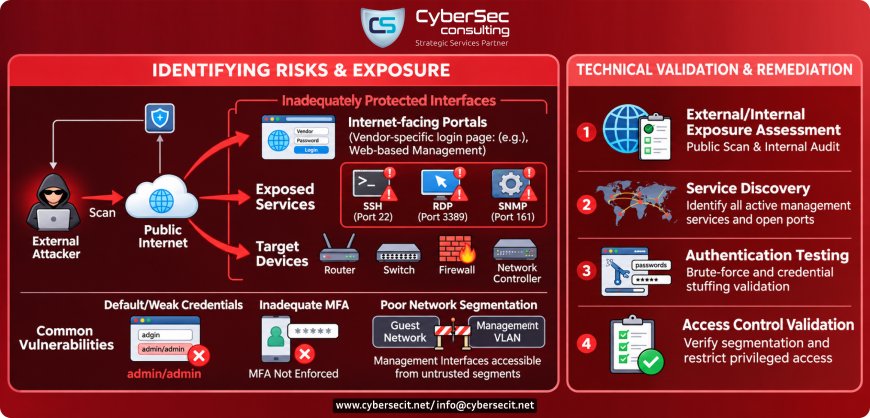
Network management interfaces play a critical role in maintaining telecom infrastructure, monitoring network performance, and controlling administrative operations. However, poorly secured management portals can expose critical network devices to unauthorised access. Telecom operators across Egypt must ensure that administrative interfaces remain protected as they expand their network infrastructure and digital services.
Internet-facing management portals, SSH, RDP, SNMP, and web-based administration services require careful security validation. Unrestricted access to these interfaces can expose routers, switches, firewalls, and network controllers to potential attacks. Weak authentication, default credentials, and inadequate Multi-Factor Authentication (MFA) can further increase security risks.
Telecom infrastructure providers in Cairo, Alexandria, Giza, and other growing technology hubs should pay particular attention to the following security areas:
- Internet-Facing Management Portals - Identify publicly accessible administrative interfaces and validate whether access is restricted to authorised users.
- Network Management Services - Examine SSH, RDP, SNMP, and web-based services for insecure configurations and unnecessary exposure.
- Network Device Security - Assess access controls across routers, switches, firewalls, and network controllers.
- Authentication Weaknesses - Identify default credentials, weak passwords, inadequate MFA, and insecure authentication mechanisms.
- Administrative Access Restrictions - Verify whether management interfaces are isolated from untrusted network segments.
- Exposed Ports and Services - Identify unnecessary open ports, outdated services, and insecure administrative endpoints.
- Privileged Access Management - Validate administrative permissions and ensure that privileged accounts have access only to authorised network resources.
Technical Security Validation
A comprehensive telecom network security assessment should include external and internal exposure assessments, network service discovery, authentication testing, and access control validation. Security teams should examine whether exposed management services can be accessed or exploited through unauthorised network connections.
Can an unauthorised user reach or interact with network management interfaces that should remain restricted?
This is a critical question for Egyptian telecom operators preparing to expand their network infrastructure. Regular network infrastructure security testing helps identify exposed administrative services, validate security controls, and reduce the risk of unauthorised access to critical telecom environments.
Network Function Access and Privilege Validation
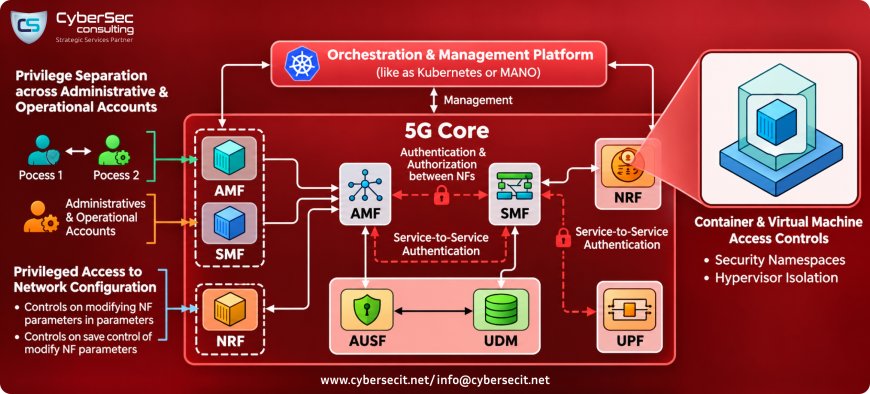
The expansion of 5G networks across Egypt is increasing the use of virtualised infrastructure, cloud native network functions, and interconnected telecom platforms. These technologies support faster connectivity and flexible network operations. However, they also introduce additional access points that require careful security validation.
Telecom operators must ensure that every network function has controlled access to the resources it needs. Weak authentication, excessive privileges, and poorly defined access policies can expose critical network functions to unauthorised users. A compromised account or network service could also create opportunities for lateral movement across telecom infrastructure.
A comprehensive 5G network security assessment should examine access controls across the following 5G Core components:
- AMF (Access and Mobility Management Function) - Validate authentication and access controls governing device registration and mobility management.
- SMF (Session Management Function) - Examine permissions and access restrictions related to session management and network connectivity.
- UPF (User Plane Function) - Validate access controls protecting user traffic processing and forwarding operations.
- AUSF (Authentication Server Function) - Assess authentication mechanisms and restrictions protecting subscriber authentication processes.
- UDM (Unified Data Management) - Examine access permissions protecting subscriber information and iidentity-relateddata.
- NRF (Network Repository Function) - Validate service discovery permissions and communication between authorised network functions.
Key Technical Areas to Validate
Egyptian telecom operators and network infrastructure providers should assess the following areas:
- Network Function Authentication - Verify whether communication between 5G Core network functions uses secure authentication and authorised service identities.
- Privilege Separation - Examine administrative and operational accounts to identify excessive permissions and unauthorised privilege escalation paths.
- Orchestration Platform Access - Validate access controls protecting network orchestration systems and centralised management platforms.
- Container and Virtual Machine Security - Assess permissions, isolation, and administrative access across virtualised telecom environments.
- Service-to-Service Authentication - Examine how network functions authenticate and authorise communication with other services.
- Network Configuration Access - Verify restrictions protecting critical configuration files, operational systems, and network management resources.
Technical Security Validation
A detailed telecom cybersecurity assessment should examine authentication mechanisms, authorisation policies, privileged access paths, service identities, and communication between network functions. Controlled security testing should identify whether compromised accounts or services can access resources beyond their authorised permissions.
Can one compromised network function or account gain access to resources beyond its authorised operational scope?
This question is particularly important for telecom operators expanding 5G infrastructure across Cairo, Alexandria, and other major Egyptian business and technology centres. Effective telecom network security testing helps identify privilege escalation risks, insecure service communication, and access control weaknesses before they affect critical network operations.
Telecom API Security and External Integrations
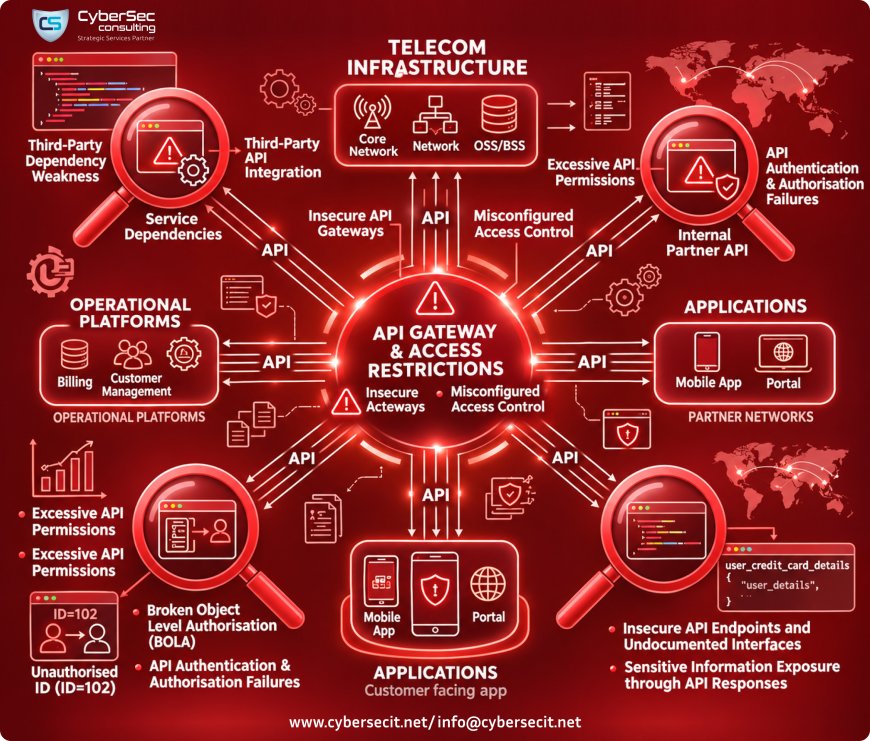
APIs play an important role in connecting telecom infrastructure, digital applications, customer platforms, and third-party service providers. Egyptian telecom operators increasingly depend on API driven services to support digital connectivity, enterprise applications, 5G services, and automated network operations. However, insecure APIs can expose sensitive network information and critical operational functions to unauthorised access.
Weak API authentication, excessive permissions, and inadequate access restrictions can create security gaps across interconnected telecom environments. Poorly secured integrations may also expose subscriber information, application data, and network management resources. These risks make API security testing an essential part of a comprehensive telecom cybersecurity assessment.
Telecom operators and network infrastructure providers across Egypt should validate the following API security areas:
- API Authentication and Authorisation - Verify that APIs authenticate users and applications correctly. Ensure that access permissions are restricted to authorised resources.
- Broken Object Level Authorisation (BOLA) - Identify whether users can access another user's records or sensitive resources by manipulating object identifiers in API requests.
- Excessive API Permissions - Examine whether applications, users, and external integrations have permissions beyond their actual operational requirements.
- Token Validation and Session Management - Assess access token security, expiration policies, session handling, and mechanisms for preventing token misuse.
- Insecure API Endpoints - Identify exposed, outdated, undocumented, or inadequately protected API endpoints connecting telecom applications and infrastructure.
- Rate Limiting and Abuse Protection - Validate whether APIs restrict excessive requests and protect against automated attacks, resource abuse, and service disruption.
- Sensitive Information Exposure - Examine API responses for unauthorised disclosure of subscriber information, authentication details, network data, and operational information.
- Third-Party API Integrations - Review connections with external service providers, enterprise applications, and technology partners to identify insecure communication and access paths.
- API Gateway Security - Validate gateway configurations, access restrictions, request filtering, and authentication enforcement across connected services.
Technical Security Validation
A structured telecom API security assessment should include API discovery, endpoint enumeration, authentication testing, authorisation testing, input validation, and business logic testing. Security teams should also examine how APIs communicate with network management platforms, cloud environments, and external applications.
Controlled API penetration testing can help identify weaknesses that automated vulnerability scans may not detect. Testing should validate whether attackers can bypass access restrictions, manipulate requests, or access sensitive resources through insecure API operations.
Can an unauthorised user or external integration access network data, operational functions, or resources beyond its intended permissions?
This is an important security consideration for telecom operators in Cairo, Alexandria, and other growing digital business centres across Egypt. Effective telecom network security testing helps identify API vulnerabilities, protect sensitive information, and strengthen the security of interconnected network infrastructure.
Network Configuration and Infrastructure Weaknesses
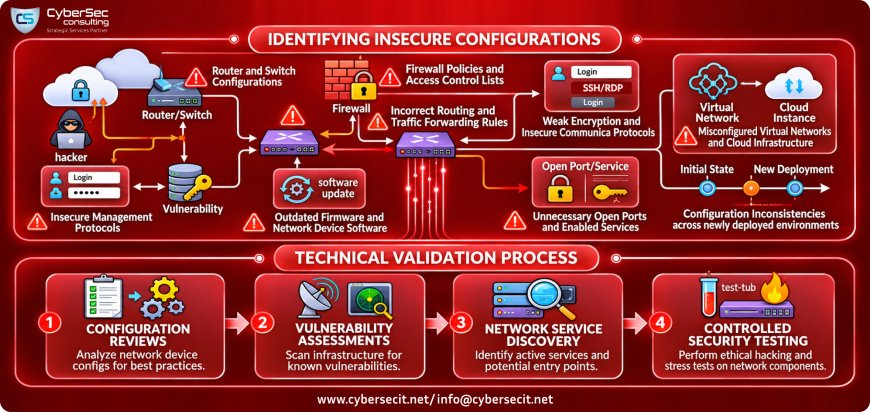
Network configurations play a major role in protecting telecom infrastructure, maintaining connectivity, and controlling communication between network devices. Egyptian telecom operators are expanding their 5G infrastructure, cloud environments, and enterprise network services. Each new deployment introduces configurations that require proper security validation.
Misconfigured routers, switches, firewalls, and network devices can create security gaps across telecom environments. Incorrect firewall rules, outdated firmware, weak encryption, and unnecessary open ports may expose critical infrastructure to unauthorised access. Configuration errors can also allow attackers to bypass security controls or gain access to sensitive network resources.
Telecom operators and network infrastructure providers across Egypt should prioritise the following areas during a network infrastructure security assessment:
- Router and Switch Configurations - Review device configurations, administrative permissions, routing settings, and access restrictions to identify insecure network configurations.
- Firewall Policies and Access Control Lists - Examine firewall rules and access control lists (ACLs) to identify excessive permissions, unrestricted traffic, and unintended access between network segments.
- Routing and Traffic Forwarding Rules - Validate routing configurations and traffic forwarding policies to identify incorrect routes, insecure communication paths, and potential traffic exposure.
- Network Management Protocols - Assess the security of SSH, SNMP, Telnet, and other management protocols. Identify insecure services and weak configurations that could expose network devices.
- Firmware and Software Vulnerabilities - Identify outdated firmware, unsupported network device software, and known vulnerabilities affecting routers, switches, firewalls, and other infrastructure components.
- Encryption and Communication Security - Examine encryption configurations and communication protocols to identify weak cryptographic settings and insecure data transmission.
- Open Ports and Unnecessary Services - Discover exposed ports, unnecessary services, and applications that increase the attack surface of telecom infrastructure.
- Virtual Network and Cloud Configurations - Validate virtual network security, cloud access permissions, network security groups, and isolation between connected environments.
- Configuration Consistency - Compare configurations across existing and newly deployed network environments to identify security gaps, inconsistent policies, and unauthorised configuration changes.
Technical Security Validation
A comprehensive telecom network security assessment should include configuration reviews, vulnerability assessments, network service discovery, and controlled security testing across infrastructure components. These activities help identify weaknesses in network devices and determine whether existing security controls are properly implemented.
Security teams should also validate firewall enforcement, network access restrictions, firmware versions, and communication security. Controlled testing can reveal configuration weaknesses that may not be identified through routine network monitoring.
Do newly deployed or existing network devices contain configuration weaknesses that could expose critical infrastructure?
This question is particularly important for telecom operators expanding their network infrastructure across Cairo, Alexandria, Giza, and other Egyptian business centres. Regular network infrastructure security testing helps identify misconfigurations, reduce unnecessary network exposure, and strengthen protection across critical telecom environments.
Why Technical Security Validation Matters for Telecom Expansion in Egypt?
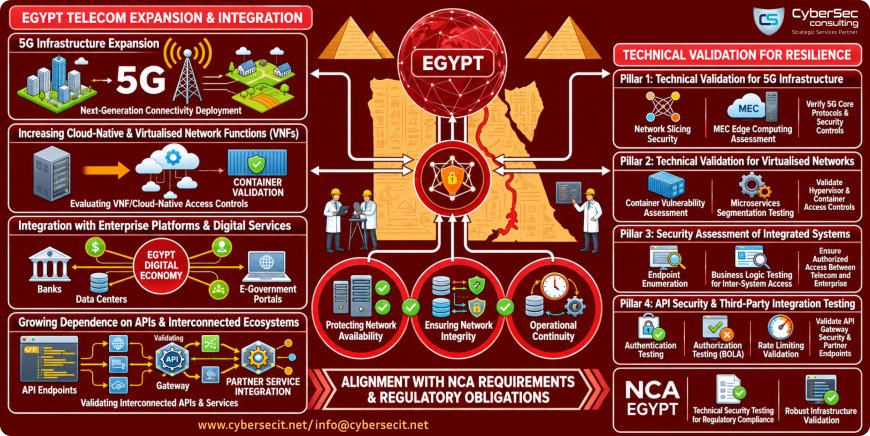
Egypt's telecommunications sector is undergoing significant digital development. Growing investments in 5G connectivity, broadband infrastructure, cloud services, and digital transformation are increasing the demand for secure and reliable network environments. Telecom operators are expanding their infrastructure to support enterprise connectivity, smart cities, financial services, and government digital platforms.
These developments also introduce new cybersecurity challenges. The growing use of virtualised network functions, cloud native infrastructure, and interconnected digital services creates additional entry points for potential attacks. Weak access controls, exposed network interfaces, and insecure API integrations can increase the risk of unauthorised access to critical telecom systems.
Telecom operators and network infrastructure providers across Cairo, Alexandria, Giza, and the New Administrative Capital should prioritise technical security validation across their expanding environments.
Several areas require particular attention:
- 5G Infrastructure Security - The expansion of 5G networks requires regular security assessments of network devices, core network functions, management interfaces, and connected infrastructure. A comprehensive 5G network security assessment helps identify vulnerabilities before they affect critical network operations.
- Cloud Native and Virtualised Network Security - Telecom operators increasingly depend on virtual machines, containers, and cloud native network functions. Security testing should validate workload isolation, access permissions, service authentication, and network segmentation.
- Enterprise Network Integration - Connections between telecom infrastructure, enterprise applications, and digital platforms can introduce additional security exposure. Network security assessments should examine communication paths, access restrictions, and authentication mechanisms across connected environments.
- API and Third Party Security - APIs support communication between telecom platforms, applications, and external service providers. API security testing should identify weak authentication, excessive permissions, insecure endpoints, and unauthorised access to sensitive network resources.
- Network Availability and Operational Continuity - Telecom infrastructure supports essential digital services and business operations. Security validation should examine weaknesses that could affect network availability, data integrity, and service continuity.
- Regulatory and Security Requirements - Telecom operators should consider applicable National Telecom Regulatory Authority (NTRA) requirements and relevant national cybersecurity frameworks when assessing their infrastructure. Technical validation should examine whether implemented security controls effectively protect network assets and sensitive operational environments.
Why Should Telecom Operators Prioritise Network Security Testing?
Network expansion requires more than deploying additional infrastructure. Operators should examine every new connection, network function, API, and administrative interface for potential security weaknesses.
A structured telecom cybersecurity assessment helps Egyptian telecom operators identify vulnerabilities, validate network access controls, assess infrastructure configurations, and understand potential attack paths. Regular telecom network security testing also provides technical evidence of security weaknesses and helps teams prioritise remediation activities.
Recommended Assessment Checklist
| Assessment area | What should be validated? |
| Management Interfaces | Exposure, authentication, administrative access |
| Network Functions | Authentication, authorisation, privilege boundaries |
| APIs | Endpoint exposure, access controls, token security |
| Configurations | Firewall policies, firmware, insecure services |
| Network Segmentation | Isolation, lateral movement, access restrictions |
| Third-Party Access | Vendor connectivity, external privileges |
| Penetration Testing | Exploitability and attack paths |
| Remediation | Risk prioritisation and retesting |
Conclusion
Telecom network expansion creates new opportunities for digital connectivity, 5G services, and enterprise infrastructure across Egypt. However, every new deployment can introduce security weaknesses that affect critical network environments. Exposed management interfaces, excessive network privileges, insecure APIs, misconfigured devices, and weak network segmentation can create potential entry points for cyberattacks.
Telecom operators and network infrastructure providers across Cairo, Alexandria, Giza, and the New Administrative Capital should prioritise technical security validation before expanding their infrastructure. A structured 5G network security assessment helps identify vulnerabilities, examine access controls, validate network configurations, and uncover potential attack paths across interconnected systems.
Regular telecom cybersecurity assessments and network infrastructure security testing also help organisations understand their security exposure and address exploitable weaknesses before they affect network availability, data integrity, or operational continuity.
Secure network expansion requires more than additional infrastructure. It requires evidence that every critical component, connection, and access point has been properly assessed.
Planning to expand your telecom infrastructure?
Validate its security before deployment.
Request a Network Security Assessment and strengthen your infrastructure before your next expansion.
What's Your Reaction?
 Like
0
 Dislike
0
 Love
0
 Funny
0
 Angry
0
 Sad
0
 Wow
0