

























AI and Data Privacy: Protecting Sensitive Information in the Age of Generative AI
Generative AI adoption across the UAE is accelerating. Learn how AI Data Privacy, AI Security, Data Protection, AI Governance, UAE PDPL Compliance, Data Classification, and AI Risk Management help organizations secure sensitive information and adopt AI responsibly.



Rise of Generative AI and the Data Privacy Challenge
Generative AI adoption is reshaping the digital landscape across the UAE, with organizations rapidly integrating artificial intelligence into daily operations, customer engagement strategies, and decision-making processes. Recent industry reports indicate that the UAE ranks among the global leaders in AI adoption, with more than 70% of the population actively using AI technologies and nearly all organizations exploring AI-driven initiatives to improve efficiency, innovation, and competitiveness.
Strong government support, ambitious digital transformation programs, and growing investments in emerging technologies continue to position the UAE as a regional hub for artificial intelligence and innovation. Generative AI solutions are no longer limited to experimental projects. Enterprises across sectors are leveraging AI-powered tools to enhance customer service through intelligent chatbots and virtual assistants, accelerate content creation for marketing and communications, and streamline software development through AI-assisted coding.
It improves business intelligence by generating actionable insights from large datasets. Growing reliance on AI enables organizations to reduce operational costs, improve productivity, and deliver more personalized experiences to customers and stakeholders. Significant business benefits are accompanied by a new set of data privacy and security challenges. Employees frequently interact with public and private AI platforms by submitting prompts, uploading documents, analyzing datasets, and automating workflows.
Sensitive information such as customer records, personally identifiable information (PII), financial data, intellectual property, proprietary source code, and confidential business documents can inadvertently be exposed when proper controls are not in place. Unauthorized data sharing, insecure AI integrations, model memorization, and insufficient governance practices can increase the risk of data leakage, regulatory violations, and reputational damage.
Growing concerns around AI data privacy, data protection, AI governance, and regulatory compliance have made security a critical component of every AI strategy. Organizations embracing Generative AI must ensure that strong privacy frameworks, robust access controls, data classification policies, encryption mechanisms, and continuous monitoring capabilities support innovation. Effective AI governance helps businesses unlock the full value of artificial intelligence while maintaining compliance with evolving data protection regulations and safeguarding sensitive information throughout the AI lifecycle.
Balancing AI innovation with data privacy is no longer optional. Organizations that adopt a privacy-first approach to Generative AI will be better positioned to reduce risk, strengthen customer trust, and achieve sustainable digital transformation in an increasingly AI-driven business environment.
Understanding Generative AI and How It Uses Data

Approximately 97% of professionals across the UAE are already using Artificial Intelligence tools for work-related activities. At the same time, enterprise investments in Generative AI, AI Security, AI Governance, and Data Privacy continue to grow rapidly.
Strong demand for AI-powered customer service, intelligent automation, business intelligence, software development, and cybersecurity solutions has accelerated the adoption of Large Language Models (LLMs) across organizations seeking greater efficiency and innovation.
Rising adoption also increases the importance of AI Data Privacy, Data Protection, AI Compliance, and Sensitive Data Security as businesses process growing volumes of critical information through AI systems.
How Large Language Models (LLMs) Process Information
Large Language Models (LLMs) are advanced AI systems trained on massive datasets containing text, code, documents, and digital content. Complex algorithms identify patterns, relationships, context, and language structures to understand user queries and generate human-like responses. Every interaction is analyzed to predict the most relevant output based on previously learned information rather than direct knowledge retrieval.
Why AI Systems Require Large Amounts of Data
Generative AI relies on extensive datasets to develop contextual understanding, improve accuracy, reduce bias, and support diverse business scenarios. Greater data volumes help AI models recognize language variations, industry terminology, customer behaviors, security threats, and operational patterns. Effective AI Governance, Data Privacy Management, Data Classification, and AI Risk Management become increasingly important as organizations across the UAE expand their use of enterprise AI platforms and data-driven innovation initiatives.
Major Data Privacy Risks Associated with Generative AI
Generative AI delivers significant business value through automation, intelligent decision-making, content generation, and operational efficiency. Growing adoption of enterprise AI platforms, Large Language Models (LLMs), and AI-powered business applications has also introduced new Data Privacy, Data Protection, and AI Security challenges that organizations cannot afford to overlook.
Every interaction with an AI system involves data processing, creating potential risks related to unauthorized access, information disclosure, regulatory compliance, intellectual property protection, and cybersecurity. Effective AI Governance, Data Classification, AI Risk Management, Sensitive Data Protection, and Privacy Compliance frameworks are essential to ensure that innovation remains aligned with security and regulatory requirements.
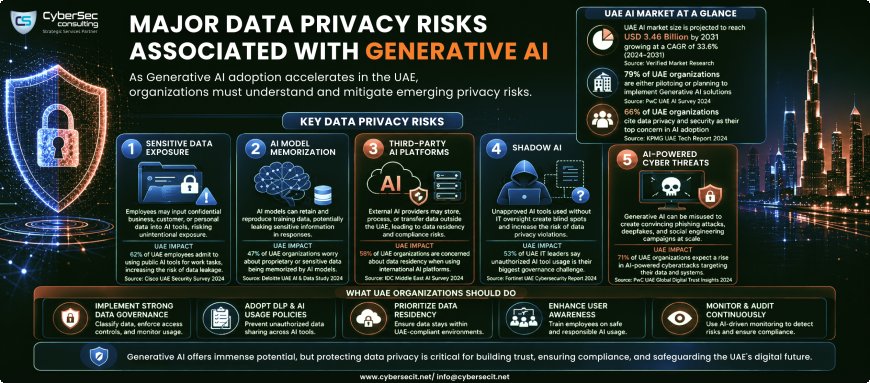
Sensitive Data Exposure
Sensitive Data Exposure occurs when employees, contractors, or business applications inadvertently submit confidential information to Generative AI platforms. Customer records, Personally Identifiable Information (PII), financial data, intellectual property, and internal business documents may become accessible beyond intended boundaries. Strong Data Loss Prevention (DLP), Data Classification, and Access Control measures help reduce the risk of unauthorized disclosure.
AI Model Memorization
AI Model Memorization refers to situations where an AI system retains portions of the data used during training or fine-tuning activities. Sensitive information embedded within training datasets may unintentionally influence future outputs, creating privacy and compliance concerns. Robust AI Governance, Privacy-by-Design practices, and secure training methodologies are critical for minimizing exposure risks.
Third-Party AI Platforms
Third-party AI platforms often require organizations to share prompts, files, datasets, or business information to generate results. Limited visibility into how external providers store, process, retain, or use submitted data can increase Data Privacy and Compliance risks. Vendor Risk Assessments, Data Protection Policies, and AI Security Reviews help ensure secure adoption of external AI services.
Shadow AI
Shadow AI emerges when employees use unauthorized AI tools without approval from IT, Security, or Compliance teams. Lack of oversight creates visibility gaps that can lead to uncontrolled data sharing, policy violations, and increased cybersecurity risks. Comprehensive AI Governance Frameworks and employee awareness programs are essential for reducing Shadow AI activity.
AI-Powered Cyber Threats
AI-powered cyber threats leverage advanced technologies to automate phishing attacks, social engineering campaigns, malware development, deepfake generation, and reconnaissance activities. Greater sophistication enables attackers to create highly convincing and scalable threats that target both organizations and individuals. Continuous Security Monitoring, Threat Intelligence, AI Security Controls, and Cybersecurity Risk Management strategies help organizations defend against evolving AI-driven attacks.
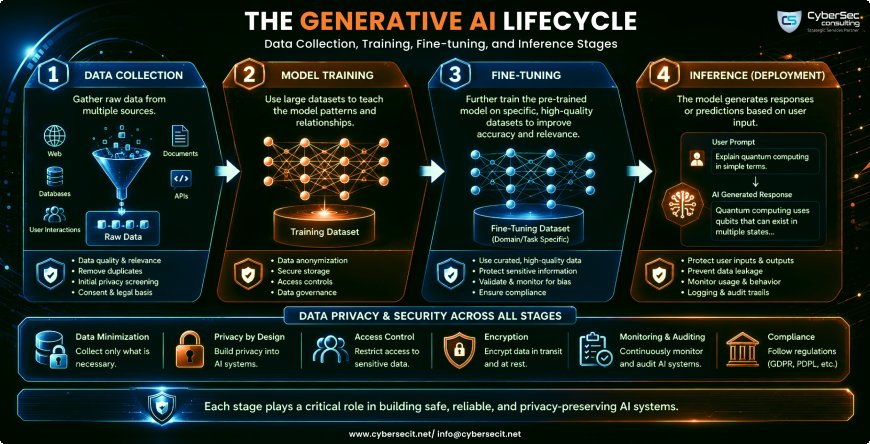
Data Collection, Model Training, and Fine-Tuning
Data collection gathers structured and unstructured information from sources such as databases, applications, documents, emails, and digital content to build the foundation of a Generative AI model.
Model training analyzes these massive datasets to identify patterns, relationships, and context, enabling AI systems to understand language and generate accurate outputs. Fine-tuning further refines the trained model using domain-specific data, improving performance, accuracy, and relevance for industries such as cybersecurity, finance, healthcare, and customer service.
Regulatory and Compliance Considerations

Regulatory compliance plays a critical role in ensuring that Generative AI technologies are deployed responsibly, securely, and in alignment with Data Privacy and Data Protection requirements. Rapid adoption of Artificial Intelligence, Large Language Models (LLMs), and AI-powered business applications has increased the need for organizations to establish strong AI Governance, Risk Management, Privacy Compliance, and Information Security frameworks.
Regulatory requirements help organizations protect sensitive information, maintain transparency, manage data processing activities, and reduce legal, financial, and reputational risks associated with AI adoption. Effective compliance strategies support secure innovation while strengthening customer trust, business resilience, and enterprise-wide cybersecurity posture.
UAE PDPL
The UAE Personal Data Protection Law (PDPL) establishes a comprehensive framework for protecting personal data and governing how organizations collect, process, store, and transfer information.
- Data Protection Requirements - Organizations must implement appropriate technical, administrative, and organizational safeguards to protect personal information against unauthorized access, misuse, disclosure, alteration, or loss. Strong Data Security, Access Management, Data Classification, Encryption, and Risk Assessment controls are essential components of compliance. Effective protection measures help ensure the confidentiality, integrity, and availability of sensitive information throughout its lifecycle.
- Consent and Processing Obligations - Personal data processing must be conducted lawfully, transparently, and for clearly defined business purposes. Individuals must be informed about how their information is collected, used, stored, and shared, while organizations must maintain accountability for all processing activities. Proper consent management and privacy controls help strengthen Data Privacy Compliance and Regulatory Governance.
GDPR
- The General Data Protection Regulation (GDPR) establishes strict requirements for personal data protection, privacy rights, transparency, and accountability.
- Organizations processing personal information must implement appropriate safeguards, maintain lawful processing practices, and ensure adequate protection of individual privacy rights.
- Strong alignment between GDPR, AI Governance, and Data Protection programs helps reduce compliance risks in global business environments.
ISO 27001
- ISO 27001 provides an internationally recognized framework for establishing, implementing, maintaining, and improving an Information Security Management System (ISMS).
- Security controls covering risk management, access control, incident response, data protection, and business continuity help organizations strengthen cybersecurity resilience.
- Effective implementation supports enterprise-wide security governance and regulatory compliance objectives.
NIST AI Risk Management Framework
- The NIST AI Risk Management Framework helps organizations identify, assess, manage, and mitigate risks associated with Artificial Intelligence systems.
- Structured guidance promotes trustworthy AI, responsible governance, privacy protection, transparency, and security throughout the AI lifecycle.
- Comprehensive risk management improves confidence in enterprise AI deployments and decision-making processes.
Emerging AI Regulations
- Emerging AI regulations focus on responsible AI development, transparency, accountability, privacy protection, cybersecurity, and ethical use of Artificial Intelligence technologies.
- Regulatory frameworks increasingly require organizations to assess AI risks, document governance practices, and protect sensitive information throughout AI operations.
- Proactive compliance strategies help businesses adapt to evolving legal requirements while supporting secure and sustainable AI innovation.
How CyberSec Helps Organizations Secure AI Adoption

Generative AI is transforming business operations, customer engagement, software development, and decision-making processes, but successful adoption requires more than deploying AI technologies. Organizations must address AI Security, Data Privacy, AI Governance, Regulatory Compliance, Cloud Security, Identity Management, and Cyber Risk Management to ensure that innovation does not introduce new vulnerabilities.
CyberSec helps organizations build a secure foundation for AI adoption by combining cybersecurity expertise, governance frameworks, risk assessments, data protection strategies, and infrastructure security controls. Comprehensive services enable businesses to leverage Artificial Intelligence, Large Language Models (LLMs), and AI-powered applications while maintaining security, compliance, and operational resilience across complex enterprise environments.
AI Security Assessments
- CyberSec's AI Security Assessments help organizations identify governance gaps, data security risks, AI application vulnerabilities, regulatory exposures, and operational weaknesses across the entire AI lifecycle.
- Structured assessments include AI inventory discovery, risk analysis, adversarial testing, shadow AI identification, and alignment with recognized frameworks such as ISO 42001 and NIST AI Risk Management Framework.
- Actionable remediation roadmaps help organizations strengthen AI Security, AI Governance, and Enterprise AI Risk Management before vulnerabilities become business liabilities.
Data Protection and Privacy Services
- CyberSec delivers end-to-end Data Protection and Privacy services designed to secure sensitive information across data at rest, data in transit, and data in use.
- Advanced Data Classification, Data Governance, Database Security, Security Monitoring, and Data Leakage Prevention capabilities help organizations maintain visibility and control over critical business information.
- Strong protection mechanisms support Privacy Compliance, Sensitive Data Protection, and secure AI adoption initiatives.
Governance, Risk, and Compliance (GRC)
- CyberSec's Governance, Risk, and Compliance services help organizations establish effective security governance, continuous monitoring, risk management, and compliance reporting processes.
- Security analytics, threat intelligence, posture monitoring, and compliance-focused assessments enable businesses to identify risks early and maintain alignment with regulatory and industry requirements.
- Comprehensive GRC programs strengthen Cyber Resilience, Security Governance, and Enterprise Risk Management across evolving digital environments.
Cloud & Infrastructure Security
- Cloud and Infrastructure Security services protect cloud environments, hybrid architectures, and on-premises systems against cyber threats, misconfigurations, data breaches, and compliance risks.
- CyberSec provides Cloud Security Posture Management (CSPM), Infrastructure Security Assessments, Identity and Access Management (IAM), Zero Trust Architecture, and continuous monitoring capabilities to improve visibility and resilience. Strong Cloud Security controls support secure AI workloads, enterprise applications, and critical digital assets.
Network & Endpoint Security
Network and Endpoint Security services help organizations identify, prioritize, and remediate vulnerabilities across networks, servers, databases, wireless environments, and endpoint devices. Advanced assessments, Endpoint Detection and Response (EDR), security hardening, vulnerability management, and threat detection capabilities reduce attack surfaces and strengthen enterprise-wide protection. Comprehensive security controls help safeguard AI ecosystems, business operations, and critical infrastructure against evolving cyber threats.
Conclusion

Artificial Intelligence is rapidly becoming a cornerstone of digital transformation strategies across the UAE, enabling organizations to accelerate innovation, improve customer experiences, enhance operational efficiency, and unlock greater business value. Industry forecasts estimate that AI could contribute hundreds of billions of dollars to the regional economy over the coming years, while UAE enterprises continue to invest heavily in Generative AI, Large Language Models (LLMs), AI-powered automation, intelligent analytics, and digital innovation initiatives. Strong adoption trends are creating significant opportunities for organizations seeking to gain a competitive advantage through data-driven decision-making and advanced AI technologies.
Growing reliance on Generative AI also brings increased responsibility to protect sensitive information, maintain regulatory compliance, and manage emerging cybersecurity risks. Customer data, Personally Identifiable Information (PII), intellectual property, confidential business information, financial records, and operational data remain valuable assets that require robust protection throughout the AI lifecycle. Effective AI Governance, AI Security, Data Privacy Management, Data Protection, Data Classification, AI Risk Management, Cloud Security, and Compliance Frameworks are essential for reducing exposure to data leakage, unauthorized access, AI-powered cyber threats, and regulatory penalties.
Organizations that embrace a privacy-first and security-first approach to AI adoption will be better positioned to maximize the benefits of Artificial Intelligence while maintaining trust, resilience, and compliance. Strong governance structures, proactive risk assessments, continuous monitoring, secure cloud environments, and comprehensive data protection controls help ensure that AI innovation remains aligned with business objectives and regulatory requirements.
CyberSec helps organizations confidently adopt and secure Generative AI through specialized AI Security Assessments, Data Protection and Privacy Services, Governance, Risk and Compliance (GRC), Cloud & Infrastructure Security, and Network & Endpoint Security solutions. Expert-led services enable businesses to strengthen AI Governance, safeguard sensitive data, achieve compliance objectives, and reduce cyber risks across complex enterprise environments.
Ready to secure your AI journey?
CyberSec offers comprehensive AI Data Privacy Services, AI Security Services, Data Protection Solutions, AI Governance Consulting, and Privacy Compliance Services designed to help organizations adopt AI securely and responsibly.
Connect with our experts today. Together, we can help you build a secure, compliant, and future-ready AI ecosystem.
FAQs
What is Generative AI and why is it important for businesses in the UAE?
Generative AI uses advanced Large Language Models (LLMs) to create content, automate tasks, and improve decision-making. Organizations across the UAE are adopting Generative AI to accelerate digital transformation and business innovation.
What are the biggest AI Data Privacy risks for UAE organizations?
Common AI Data Privacy risks include sensitive data exposure, unauthorized data sharing, AI model memorization, Shadow AI, and third-party AI platform vulnerabilities. Strong AI Governance and Data Protection controls help mitigate these risks.
How can organizations protect sensitive data when using Generative AI?
Businesses can strengthen AI Data Protection by implementing Data Classification, Data Loss Prevention (DLP), Encryption, Access Controls, and AI Security Monitoring. These measures help secure Personally Identifiable Information (PII) and confidential business data.
How does UAE PDPL impact Generative AI adoption?
UAE PDPL requires organizations to process personal data lawfully, transparently, and securely. Compliance with UAE Data Privacy regulations is essential when deploying AI-powered applications and Large Language Models.
Why is AI Governance important for enterprise AI security?
AI Governance establishes policies, risk management processes, and security controls that ensure responsible AI adoption. Effective AI Governance helps organizations maintain compliance, reduce cyber risks, and protect sensitive information.
How can CyberSec help organizations secure Generative AI environments?
CyberSec provides AI Security Assessments, AI Data Privacy Services, Data Protection Solutions, Governance Risk and Compliance (GRC), and Cloud Security services. Expert-led solutions help UAE organizations adopt AI securely while maintaining regulatory compliance.
What's Your Reaction?
 Like
0
Like
0
 Dislike
0
Dislike
0
 Love
0
Love
0
 Funny
0
Funny
0
 Angry
0
Angry
0
 Sad
0
Sad
0
 Wow
0
Wow
0