





















One Click, One Malicious Ad, & One Major Business Disruption
Learn how malvertising threatens businesses through malicious online ads and discover how DNS Security, EDR, Zero Trust, SIEM, VAPT, and Threat Intelligence can protect your organization from cyberattacks.



Introduction
Recent cybersecurity reports indicate that over 90% of successful cyberattacks begin with some form of user interaction, while malicious websites, phishing campaigns, and compromised online content continue to rank among the leading causes of enterprise security incidents. At the same time, billions of digital advertisements are served every day across news portals, business websites, search engines, social media platforms, and mobile applications, making online advertising one of the largest distribution channels on the internet.
As organizations accelerate digital transformation, cloud adoption, hybrid work, and online business operations, cybercriminals are increasingly exploiting these trusted digital ecosystems to deliver malware, steal credentials, and infiltrate corporate networks.
For organizations operating in sectors such as banking, healthcare, government, education, manufacturing, retail, energy, telecommunications, and logistics, the consequences can include financial losses, operational disruption, regulatory penalties, reputational damage, and prolonged business downtime.
Online advertising has become an essential part of the global digital economy, enabling businesses to connect with customers through trusted websites and legitimate advertising networks. Unfortunately, threat actors are now leveraging these same platforms to distribute malicious code, redirect users to fraudulent websites, and launch sophisticated cyberattacks without raising immediate suspicion.
This means businesses no longer need to visit suspicious or unauthorized websites to become victims - a single malicious advertisement displayed on a reputable platform can be enough to compromise an endpoint, steal sensitive information, or provide attackers with an entry point into the corporate environment.
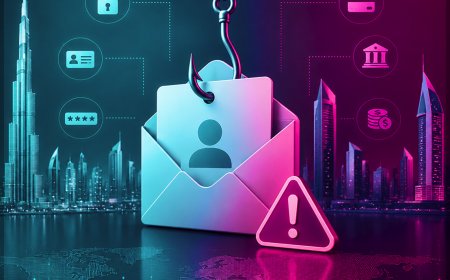
This increasingly sophisticated attack technique is known as Malvertising (Malicious Advertising), a growing cybersecurity threat that combines online advertising with malware delivery to target organizations of all sizes across every industry.
What Is Malvertising?
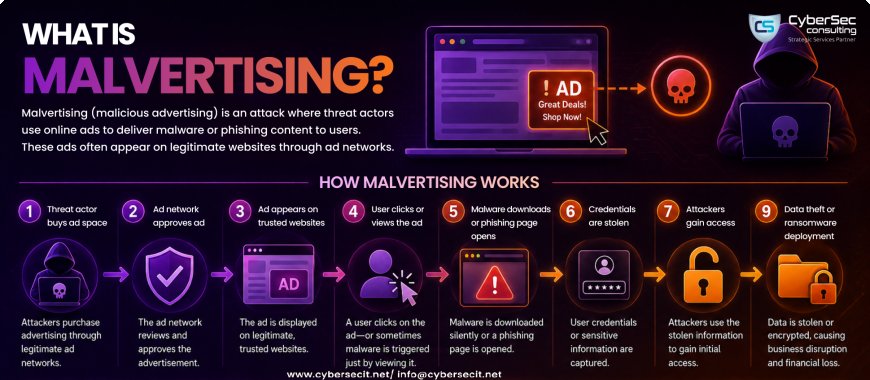
Malvertising (Malicious Advertising) is a cyberattack technique where cybercriminals use legitimate online advertising platforms to distribute malware, redirect users to fraudulent websites, steal sensitive information, or exploit software vulnerabilities. Unlike conventional attacks that rely on suspicious websites or unsolicited emails, malvertising can appear on trusted news portals, business websites, e-commerce platforms, search engines, and mobile applications, making it difficult for users and organizations to detect.
As businesses continue adopting cloud services, remote work, and digital-first operations, malvertising has become a growing enterprise cybersecurity risk, impacting organizations across industries such as banking, healthcare, government, manufacturing, retail, education, energy, and telecommunications.
How Malicious Advertisements Work?
- Cybercriminals purchase advertising space or compromise legitimate ad networks to distribute malicious advertisements.
- When users click - or in some cases simply view - the ad, malware is delivered, or they are redirected to attacker-controlled websites.
Difference Between Malvertising and Phishing
- Malvertising uses online advertisements on legitimate websites to deliver malware or redirect victims to malicious content.
- Phishing typically relies on fraudulent emails, messages, or fake communications designed to trick users into revealing sensitive information.
Why Legitimate Websites Can Unknowingly Serve Malicious Ads?
- Most websites rely on third-party advertising networks that automatically deliver advertisements in real time.
- If attackers successfully infiltrate an ad network, malicious advertisements can appear on trusted websites without the website owner's knowledge.
Common Malvertising Attack Techniques
- Fake Software Updates - Users are tricked into downloading fake browser, Flash, PDF, or application updates that contain malware. Once installed, attackers can gain unauthorized access to systems or deploy ransomware.
- Browser Redirects - Clicking a malicious advertisement silently redirects users to phishing websites or malware-hosting pages. These redirects often imitate trusted brands to increase the chances of user interaction.
- Drive-by Downloads - Malware downloads automatically when a vulnerable browser loads a compromised advertisement. No file download confirmation or user interaction may be required on unpatched systems.
- Fake Login Pages - Malicious ads redirect users to counterfeit login portals that closely resemble legitimate services. Stolen usernames and passwords can be used to compromise business applications and cloud accounts.
- Malicious JavaScript - Hidden JavaScript code embedded within advertisements executes automatically inside the user's browser. It can fingerprint devices, exploit browser vulnerabilities, or redirect users to malicious destinations.
- Exploit Kits - Exploit kits scan browsers, plugins, and operating systems for known security vulnerabilities. If weaknesses are detected, malware is deployed automatically without requiring additional user actions.
How Does a Malvertising Attack Work?
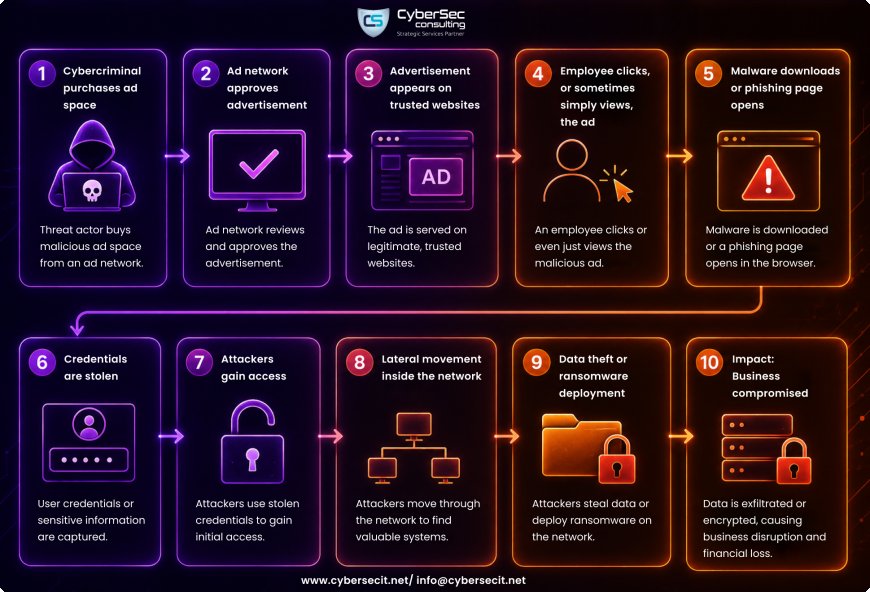
A malvertising attack often follows a well-planned sequence that enables cybercriminals to compromise business environments without directly targeting the organization's infrastructure. By abusing trusted advertising platforms and legitimate websites, attackers can bypass standard security controls and gain access to enterprise networks. Understanding this attack lifecycle helps organizations strengthen their cybersecurity strategy, improve threat detection, and reduce the risk of data breaches, ransomware attacks, and credential theft.
Malvertising Attack Lifecycle
- Cybercriminal purchases or compromise online advertising space to distribute malicious advertisements through legitimate ad networks.
- The advertising network unknowingly approves the malicious advertisement, allowing it to enter the digital advertising ecosystem.
- The malicious advertisement is displayed on trusted news, business, e-commerce, or industry websites visited by employees.
- An employee clicks - or in some cases simply views - the advertisement, triggering the attack through the browser.
- Malware is downloaded automatically, or the user is redirected to a fake login page designed to harvest sensitive information.
- User credentials, session cookies, or sensitive business data are captured through phishing pages or malicious scripts.
- Attackers use the stolen credentials to gain unauthorized access to corporate applications, cloud services, or enterprise systems.
- The threat actor moves laterally across the network, escalating privileges and identifying high-value assets.
- The attack concludes with data exfiltration, ransomware deployment, financial fraud, or business disruption, causing operational and reputational damage.
Why Businesses Should Be Concerned About Malvertising?

Malvertising is no longer just an IT issue - it is a significant business risk that can impact organizations of every size and industry. As businesses embrace cloud computing, digital transformation, hybrid work, online banking, e-commerce, and connected enterprise systems, cybercriminals are increasingly using malicious advertisements to bypass traditional security controls and compromise corporate environments.
A single malicious advertisement can trigger a chain of events that results in financial losses, operational disruption, regulatory penalties, and long-term reputational damage. For organizations operating in Banking & Financial Services, Healthcare, Government, Manufacturing, Retail, Education, Energy, Telecommunications, and Logistics, understanding these business impacts is essential to building a resilient cybersecurity strategy.
Business Impact of Malvertising
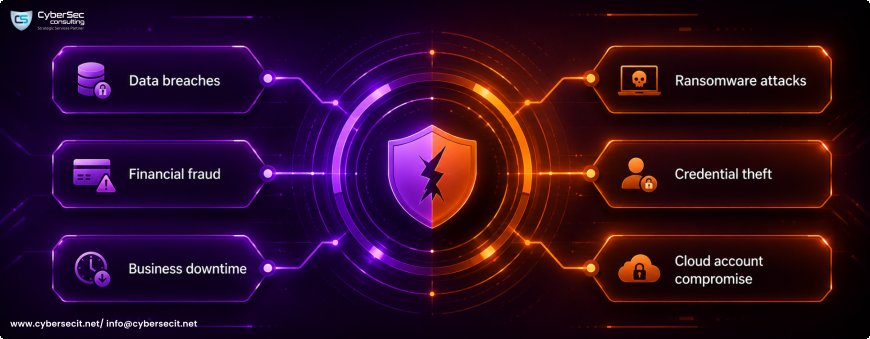
- Data Breaches - Sensitive customer, financial, healthcare, and intellectual property data can be exposed through compromised systems.
- Financial Fraud - Stolen credentials and unauthorized transactions can result in direct financial losses and payment fraud.
- Business Downtime - Malware infections can interrupt critical business operations, reducing productivity and revenue.
- Ransomware Attacks - Malvertising can serve as the initial entry point for ransomware that encrypts business-critical systems.
- Credential Theft - Fake login pages can steal employee usernames, passwords, and multi-factor authentication credentials.
- Cloud Account Compromise - Stolen cloud identities can provide attackers with unauthorized access to enterprise cloud environments.
- Regulatory Compliance Violations - Security incidents may lead to non-compliance with data protection and industry regulations.
- Operational Disruption - Business processes, supply chains, and essential services can be interrupted by cyberattacks.
- Reputation Damage - Public security incidents can negatively impact brand reputation, investor confidence, and business relationships.
- Customer Trust Erosion - Clients may lose confidence in organizations that fail to adequately protect sensitive information.
Why Standard Security Strategies Are No Longer Enough?

Standard cybersecurity solutions were designed to detect known threats, block suspicious websites, and identify malware based on predefined signatures. However, today's threat landscape has changed dramatically. Modern cybercriminals are leveraging artificial intelligence (AI), automation, malicious advertising campaigns, and advanced evasion techniques to bypass conventional security controls.
AI-powered attack tools can rapidly generate convincing fake advertisements, create realistic phishing pages, automate malware delivery, and adapt malicious content to evade detection systems.
As organizations accelerate digital transformation, cloud adoption, remote work, and browser-based business operations, malicious advertisements have become an increasingly effective attack vector because they exploit trusted digital ecosystems rather than obviously suspicious websites.
Unlike conventional cyberattacks, modern malvertising campaigns are designed to blend seamlessly into legitimate online advertising networks, making them significantly harder to detect. A malicious advertisement displayed on a trusted website can silently redirect users, execute browser-based attacks, or steal credentials without immediately triggering traditional antivirus solutions.
This evolving threat landscape requires organizations to move beyond perimeter-based security and adopt a layered cybersecurity strategy that combines prevention, detection, response, identity protection, continuous monitoring, and employee awareness to defend against sophisticated cyber threats.
Why Modern Malvertising Attacks Are More Dangerous?
- Uses Legitimate Websites - Attackers abuse trusted news, business, and industry websites to deliver malicious advertisements.
- Encrypts Malicious Traffic - Encrypted HTTPS communications help malicious activity blend in with normal web traffic.
- Uses Fileless Malware - Many attacks execute directly in memory, leaving little or no malicious files for antivirus tools to detect.
- Exploits Browsers and Applications - Cybercriminals target browser vulnerabilities, plugins, and unpatched software to gain initial access.
- Bypasses Signature-Based Detection - AI-assisted malware constantly evolves, making traditional signature-based antivirus less effective.
- Targets User Identities Instead of Devices - Stolen credentials provide attackers direct access to cloud platforms, business applications, and enterprise systems without compromising the endpoint first.
- Leverages AI to Evade Security Controls - AI-generated phishing pages, adaptive malicious advertisements, and automated attack techniques increase the success rate of modern malvertising campaigns.
- Exploits Human Trust - Employees are more likely to trust advertisements displayed on reputable websites, making social engineering significantly more effective.
How CyberSec Consulting Helps Protect Your Business Against Malvertising?
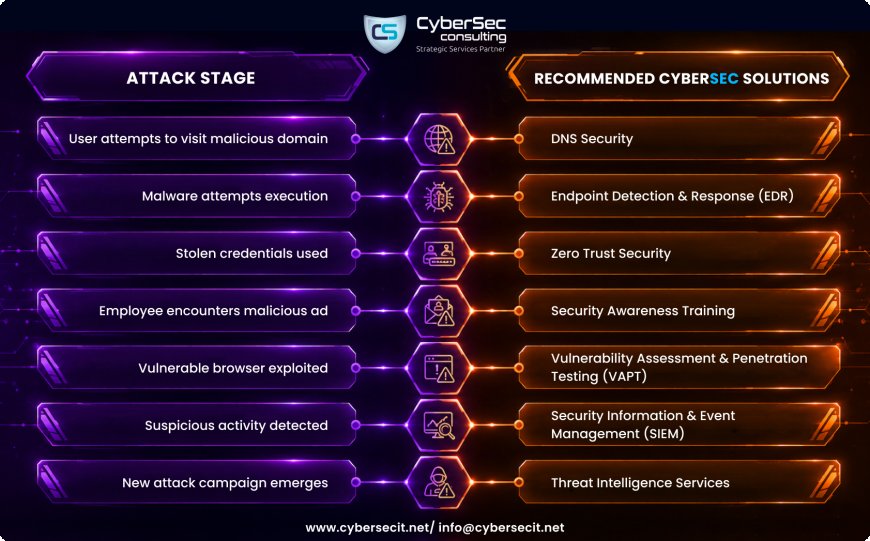
Modern malvertising attacks are designed to bypass traditional security controls by exploiting trusted websites, cloud applications, user identities, and browser vulnerabilities. To effectively defend against these sophisticated cyber threats, organizations require a layered cybersecurity strategy that combines preventive, detective, and responsive security controls. CyberSec Consulting helps businesses strengthen their cyber resilience through integrated security solutions that protect users, endpoints, networks, cloud environments, and critical business assets.
DNS Security
- DNS Security acts as the first line of defense by preventing users from connecting to malicious domains before an attack can begin, reducing the risk of malware infections, phishing attacks, and ransomware delivery.
- DNS filtering and domain reputation analysis automatically block access to malicious, suspicious, or newly registered domains associated with cybercriminal activity.
- Command-and-control (C2) blocking and phishing domain detection prevent compromised devices from communicating with attacker-controlled servers and stop users from accessing fraudulent websites.
Endpoint Detection & Response (EDR)
- Modern malware often bypasses standard solutions. Endpoint Detection & Response (EDR) continuously monitors endpoint activity to identify suspicious behavior and rapidly contain threats.
- Behavioral analytics and zero-day threat detection identify abnormal activities and previously unknown malware that signature-based solutions may miss.
- Automated isolation, ransomware prevention, and proactive threat hunting rapidly contain compromised endpoints before threats spread across the enterprise.
Zero Trust Security: Never Trust
- Zero Trust Security eliminates implicit trust by continuously verifying every user, device, application, and access request, regardless of where the connection originates.
- Least-privilege access and continuous identity verification ensure users receive only the permissions required to perform their job functions.
- Device validation, continuous authentication, and microsegmentation** limit lateral movement and prevent attackers from accessing sensitive systems.
Security Awareness Training
- Employees remain one of the most targeted entry points for malware attacks. Regular cybersecurity awareness training helps users recognize and respond to evolving online threats.
- Training on fake advertisements, browser security, safe downloading practices, and phishing awareness helps employees identify suspicious online activity before interacting with it.
- Social engineering education and procedures for reporting suspicious websites strengthen organizational security culture and improve incident response.
Vulnerability Assessment & Penetration Testing (VAPT)
- Regular security assessments help organizations identify vulnerabilities before cybercriminals can exploit them through malvertising campaigns.
- Assess browser vulnerabilities, unpatched systems, and security misconfigurations that could allow attackers to compromise enterprise devices.
- Evaluate web application security and reduce the organization's attack surface by identifying exploitable weaknesses before deployment.
Security Information & Event Management (SIEM)
- SIEM provides centralized visibility across the organization's security infrastructure, enabling faster detection and response to suspicious activities.
- Continuous monitoring, event correlation, log analysis, and automated threat detection identify malicious activity across endpoints, networks, and cloud environments.
- Automated alerts and Security Operations Center (SOC) integration enable security teams to investigate and respond to threats in real time.
Threat Intelligence Services
- Threat Intelligence enables organizations to proactively identify emerging cyber threats before they become major security incidents.
- Monitor emerging malvertising campaigns, malware trends, and Indicators of Compromise (IOCs) to identify evolving attack techniques targeting businesses.
- Leverage domain intelligence and proactive threat hunting to detect malicious infrastructure and strengthen defensive security controls.
Conclusion

Malvertising has evolved into far more than a cybersecurity concern - it is a critical business risk that can impact an organization's financial stability, operational continuity, regulatory compliance, and brand reputation. As cybercriminals increasingly leverage AI-powered attack techniques, malicious advertising campaigns, cloud-based threats, and identity-focused attacks, businesses can no longer rely solely on traditional security controls to defend their digital environments.
A single malicious advertisement can become the gateway to data breaches, ransomware attacks, credential theft, cloud account compromise, and costly business disruption, affecting organizations across every industry. Protecting modern enterprises requires a proactive, layered cybersecurity strategy that secures users, identities, endpoints, networks, cloud workloads, and business-critical applications before attackers can exploit them.
By combining preventive, detective, and responsive security measures, organizations can significantly reduce their attack surface, improve cyber resilience, and maintain compliance with evolving security and privacy regulations. Investing in cybersecurity today is not just about preventing attacks - it is about ensuring business continuity, protecting customer trust, and enabling secure digital transformation in an increasingly complex threat landscape.
CyberSec Consulting helps organizations strengthen their cybersecurity posture with comprehensive security services designed to defend against modern threats like malvertising. Whether you're strengthening your enterprise security architecture, securing cloud environments, protecting business-critical applications, or improving your organization's cyber resilience.
CyberSec Consulting provides the expertise, implementation, and managed security solutions needed to stay ahead of evolving cyber threats. Connect with CyberSec Consulting today and build a future-ready security strategy that protects your business before the next attack begins.
What's Your Reaction?
 Like
0
Like
0
 Dislike
0
Dislike
0
 Love
0
Love
0
 Funny
0
Funny
0
 Angry
0
Angry
0
 Sad
0
Sad
0
 Wow
0
Wow
0