

















Why 93% of UK Businesses Experienced Cyber Incidents in 2026
Explore UK cybersecurity statistics 2026, rising cyber threats, ransomware attacks, cloud security risks, cybersecurity consulting services UK, managed SOC services London, SIEM solutions, MDR services, vulnerability assessments, cyber resilience solutions for British businesses.

Introduction
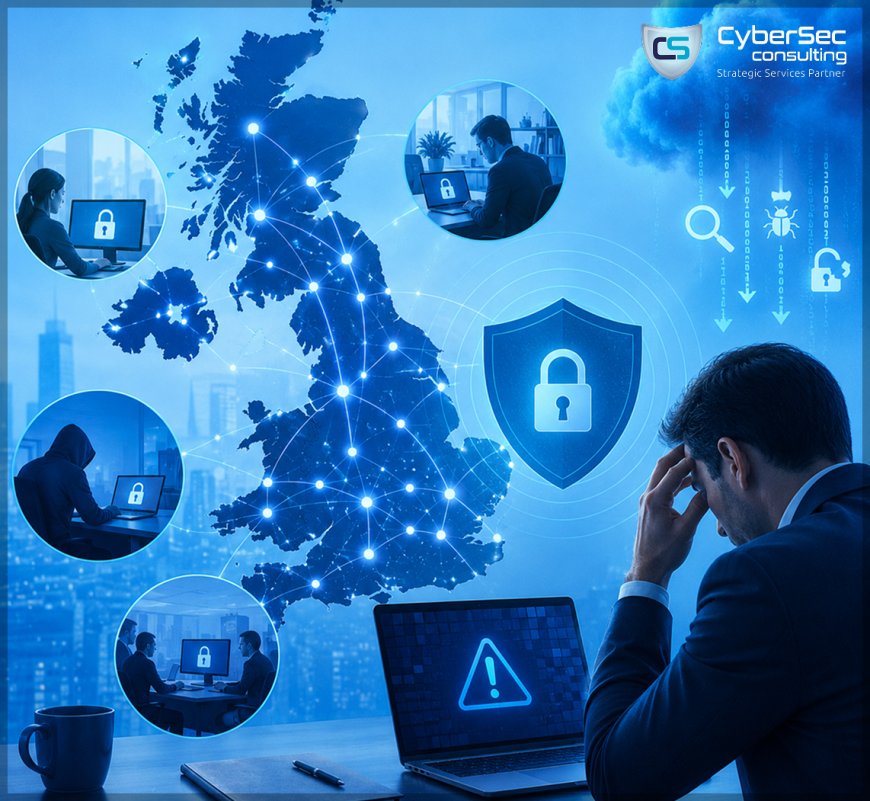
The UK cybersecurity landscape is evolving rapidly, and businesses across London and the wider UK are facing a dramatic rise in cyber threats, ransomware attacks, phishing campaigns, cloud security risks, and data breaches. From SMEs and fintech startups to healthcare providers, law firms, retail companies, and enterprise organisations, no industry is immune to the growing wave of cyber attacks targeting British businesses.
Growing Cyber Threat Landscape in the UK

Cybersecurity risks across Britain continue to rise in 2026, creating serious operational, financial, regulatory, and reputational challenges for organisations in London, Manchester, Birmingham, Leeds, Bristol, Edinburgh, and other major commercial regions. Rapid digital transformation, rising cloud adoption, the expansion of remote workforces, and sophisticated ransomware campaigns continue to push British companies toward higher exposure levels.
Recent findings published through the UK Government Cyber Security Breaches Survey 2025/ 2026 revealed alarming numbers regarding cybersecurity breaches affecting British organisations. Around 43% of UK businesses, alongside 28% of charities,s suffered cybersecurity breaches or cyber attacks during the previous twelve months. Large enterprises alongside medium-sized organisations faced significantly higher attack rates approaching nearly 70%.
British enterprises currently face relentless pressure through advanced phishing attacks, ransomware operations, credential theft campaigns, supply chain compromises, business email compromise attacks, insider threats, cloud security vulnerabilities, and endpoint security weaknesses. Threat actors continuously search for exploitable gaps across business networks, SaaS applications, remote endpoints, identity management systems, and digital infrastructure.
National Cyber Security Centre (NCSC) data further highlights sharp growth regarding nationally significant cyber incidents affecting UK critical sectors. Security experts continue observing higher volumes regarding AI-powered cyber attacks, automated phishing campaigns, deepfake fraud schemes, advanced malware variants, and financially motivated ransomware groups targeting British organisations.
Hybrid working models, multi-cloud environments, IoT device adoption, remote collaboration platforms, and third-party integrations continue expanding digital attack surfaces throughout UK enterprises. Greater dependency upon connected technologies creates additional security complexities for CISOs, IT leaders, compliance managers, and security operations teams throughout the London business sectors.
Why Cyber Attacks in UK Businesses Are Increasing?

AI-Powered Cyber Threats
Artificial intelligence is reshaping the threat landscape. Cybercriminals are now using AI to automate phishing campaigns, create convincing fake emails, generate deepfake content, and identify vulnerabilities faster than ever before.
Phishing Remains the Biggest Entry Point
Despite advances in cybersecurity technologies, phishing continues to dominate UK cybercrime statistics. According to UK government research, phishing accounted for 93% of cyber crimes experienced by UK businesses.
Employees continue to fall victim:
- Fake Microsoft 365 login pages
- Invoice fraud
- Credential theft attacks
- Malicious attachments and links
Weak Vulnerability Management
Unpatched systems remain one of the easiest ways for attackers to compromise organisations.
Many UK businesses struggle with:
- Delayed patching cycles
- Outdated operating systems
- Legacy applications
- Poor visibility into vulnerabilities
Lack of Cybersecurity Readiness Among SMEs
Small and medium-sized businesses remain one of the most vulnerable sectors in the UK.
Research shows:
- 32% of UK SMEs have no cybersecurity protections in place.
- More than half of SME employees receive no cybersecurity training.
- Many SMEs invest less than £100 annually in cybersecurity.
- 28% of SMEs believe a single attack could put them out of business.
Financial Impact of Cyber Incidents
Cyber incidents continue creating severe financial pressure across British organisations, especially across London-based enterprises, fintech companies, healthcare providers, retail businesses, legal firms, manufacturing sectors, and professional service providers. Modern cyber threats no longer create temporary IT disruptions alone. Every successful cyber attack creates long-term operational, commercial, regulatory, and reputational consequences capable of affecting overall business stability.
Business leaders across Britain increasingly recognise cybersecurity investment as a critical requirement for business continuity, digital resilience, regulatory readiness, customer confidence, and commercial protection. Ransomware attacks, phishing campaigns, insider threats, cloud security breaches, and business email compromise attacks frequently create massive recovery challenges for organisations lacking proactive cybersecurity strategies. The cost of cyber attacks in the UK continues to rise sharply.
Recent reports estimate:
- Average cyber incident recovery costs reach £2.5 million.
- UK cyber insurance payouts increased by 230%.
- UK SMEs lose approximately £3.4 billion annually due to poor cybersecurity practices.
Beyond financial losses, cyber incidents can also result in:
- Operational downtime
- Regulatory penalties
- Data loss
- Customer trust issues
- Legal liabilities
How UK Businesses Can Reduce Cyber Risks

To combat growing UK cyber threats, organisations must move from reactive security to proactive cyber resilience.
Advisory & Consulting
CyberSec Consulting delivers comprehensive cybersecurity advisory consulting services designed for helping enterprises identify risks, strengthen governance programmes, improve compliance readiness, and build resilient cybersecurity strategies aligned with organisational objectives.
CyberSec Consulting advisory consulting services include:
- Cybersecurity strategy development
- Cyber risk management consulting
- Regulatory compliance advisory
- ISO 27001 consulting
- PCI DSS consulting
- GDPR advisory services
- Security governance consulting
- Cloud security assessments
- Identity access management consulting
- SOC advisory consulting
- Cyber resilience planning
- Business continuity advisory
- Security maturity assessments
Managed Identity Security Services
Managed security services provide continuous protection against modern cyber threats targeting UK enterprises. Businesses increasingly require expert-driven cybersecurity operations capable of identifying suspicious activity, malicious behaviour, and security incidents before operational disruption occurs.
CyberSec Consulting managed security services include:
- Constant security monitoring
- Threat detection response
- Endpoint security management
- Security incident analysis
- Threat intelligence services
- Security log monitoring
- Cloud security monitoring
- Security event management
Vulnerability Management Services
Continuous vulnerability management remains critical for reducing exploitable attack surfaces across modern enterprise infrastructure. Unpatched systems, outdated applications, and exposed services frequently create entry points for ransomware groups, threat actors, and malicious insiders.
CyberSec Consulting vulnerability management services include:
- Regular vulnerability assessments
- Continuous vulnerability scanning
- Patch management support
- Asset discovery analysis
- Risk prioritisation
- Security remediation tracking
- Exposure management
- Compliance-focused reporting
Assessment Services
Comprehensive cybersecurity assessments help organisations identify security gaps, operational weaknesses, compliance risks, and exposed attack surfaces across enterprise environments. Security assessments provide greater visibility regarding infrastructure security posture, threat exposure levels, and remediation priorities.
CyberSec Consulting assessment services include:
- Vulnerability assessments
- Penetration testing services
- Cloud security assessments
- Network security assessments
- Web application security testing
- Security posture reviews
- Risk assessment programmes
- Compliance readiness assessments
Conclusion

UK cybersecurity statistics during 2026 clearly highlight growing cybersecurity risks affecting businesses across London, Manchester, Birmingham, Leeds, Edinburgh, and major commercial sectors throughout Britain. Cyber incidents no longer represent isolated events targeting large enterprises alone. Modern ransomware attacks, phishing campaigns, cloud security breaches, insider threats, and business email compromise incidents continue impacting organisations regardless of industry sector or business size.
Rising cyber threats continue to create serious operational disruption, regulatory challenges, financial exposure, a nd reputational damage across British enterprises. Traditional security approaches no longer provide sufficient protection against sophisticated threat actors leveraging AI-powered attack techniques, automated malware campaigns, and advanced social engineering tactics.
Businesses prioritising cybersecurity consulting services UK, managed security services London, cyber resilience consulting, vulnerability assessments, cloud security consulting, SOC services, SIEM solutions, penetration testing services, gain stronger protection against evolving cyber risks threatening operational stability.
CyberSec Consulting delivers top-tier cybersecurity services, cybersecurity consulting solutions, managed security services, and cyber resilience programmes designed for protecting modern enterprises across London and the broader UK markets.
Strengthen business resilience, reduce cyber risk exposure, and secure digital infrastructure through trusted cybersecurity experts delivering scalable service-based cybersecurity solutions tailored for modern UK enterprises.
What's Your Reaction?
 Like
0
Like
0
 Dislike
0
Dislike
0
 Love
0
Love
0
 Funny
0
Funny
0
 Angry
0
Angry
0
 Sad
0
Sad
0
 Wow
0
Wow
0