


























Threat Modelling vs Attack Surface Analysis: A Complete Security Comparison
Learn how Threat Modeling and Attack Surface Analysis strengthen cybersecurity, reduce attack surfaces, prevent breaches, and secure cloud, apps, APIs, and identities.



Introduction
Digital assets start with clearly identifying where risks exist and how attackers may attempt to exploit them. Two critical security practices - Threat Modeling and Attack Surface Analysis. They both play a vital role in strengthening an organization’s security posture. While both focus on risk identification and mitigation, they approach the challenge from different perspectives.
Can you protect what you cannot see?
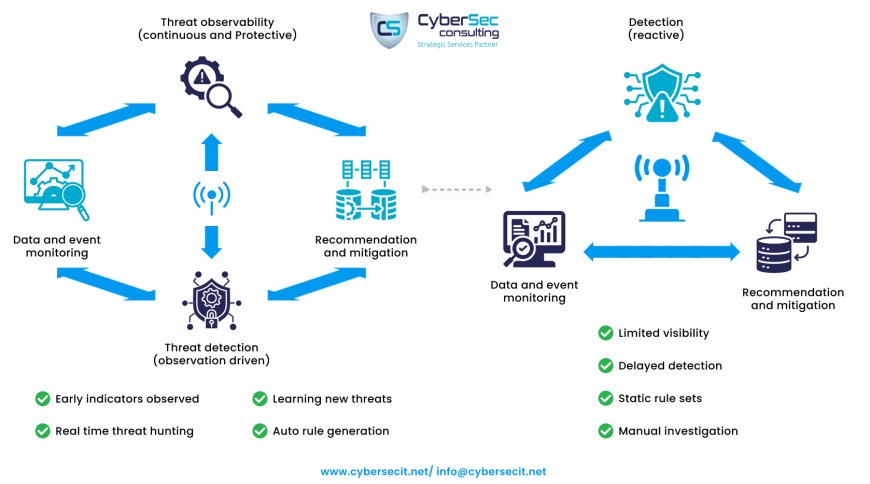
Effective cybersecurity starts with visibility across the digital attack surface. As illustrated in the diagram, raw security data and event telemetry are first centralized, correlated, and enriched with critical context such as network topology, assets, identities, workloads, and security policies. This enriched data is then processed by a machine reasoning and analytics engine, which transforms observations into threat observability early, explainable insights into security posture drift, attack precursors, and emerging risks.
Such intelligent driven process generates two powerful outcomes. The first delivers proactive security control recommendations, such as policy hardening, access control optimization, and configuration improvements to reduce cyber risk. The second enables observation-driven threat detection, identifying suspicious activities like rogue nodes, anomalous behavior, or unauthorized access, complete with confidence scoring and business impact analysis.
These insights guide automated and manual response actions, which are executed and continuously validated. The results are then fed back into the observability layer, creating a closed-loop security feedback system that continuously refines detection models, policies, and risk assessments. This approach strengthens threat detection and response (TDR), attack surface management, cloud security posture management, and zero-trust security strategies, enabling organizations to stay ahead of evolving cyber threats.
Threat Modelling
Threat modeling is a systematic cybersecurity practice used to identify, evaluate, and prioritize risks affecting technology systems. It plays a crucial role in risk management, application security, and cyber threat intelligence (CTI) by enabling informed security decisions early in the lifecycle. When implemented effectively, threat modeling acts as a security blueprint, revealing potential vulnerabilities and attack paths so organizations can apply targeted, risk-based mitigation strategies.
A comprehensive threat model typically includes:
- A clear definition of the system, application, or process being analyzed.
- Documented assumptions that can be reviewed as the threat landscape evolves.
- Identification of potential threats, vulnerabilities, and attack vectors.
- Recommended security controls and mitigation measures for each risk.
- Validation methods to assess threat accuracy and verify mitigation effectiveness.
Threat modeling follows established frameworks, such as
- Designing and optimizing SIEM data pipelines.
- Anomaly detection and behavioral analysis.
- Building and continuously refining AI-driven risk profiling models.
One of the key strengths of threat modeling is its flexibility and tool-agnostic nature. It can be applied across software applications, cloud environments, networks, distributed systems, IoT devices, and business processes.
Benefits of Threat Modeling
Threat modeling delivers measurable value by helping organizations proactively manage cybersecurity risks, strengthen application security, and improve overall risk governance. It provides a structured approach to identifying vulnerabilities early and aligning security efforts with real-world threats.
- Clear visibility into security requirements -
- Proactive prevention with faster feedback and lower costs -
- Higher product quality and stronger security confidence -
Attack Surface Analysis
Cloud environments are highly dynamic, driven by ephemeral resources, auto-scaling workloads, serverless architectures, and continuously changing infrastructure. This rapid evolution significantly increases the cloud attack surface, often outpacing the ability of traditional security tools to maintain visibility and control across cloud assets.
A comprehensive Attack Surface Analysis includes
- Comprehensive Asset Discovery and Inventory -
- Detect Internet-Facing and External Exposure -
- Analyze Internal Reachability and Lateral Movement Paths -
- Assess Misconfigurations and Security Weaknesses -
- Risk-Based Prioritization of Threats -
- Continuous Attack Surface Monitoring and Drift Detection -
Benefits of Attack Surface Analysis
- Stronger Cybersecurity Posture -
- Proactive Risk Reduction -
- Complete Asset and Threat Visibility -
- Faster Detection and Incident Response -
Conclusion

Threat Modeling and Attack Surface Analysis are complementary cybersecurity practices that, when combined, provide a comprehensive and proactive defense strategy. Threat modeling enables organizations to anticipate attacker behavior, identify high-risk threat scenarios, and embed security early into system design and development. At the same time, attack surface analysis delivers continuous visibility into exposed assets, misconfigurations, identities, and external entry points across cloud, hybrid, and on-prem environments.
Together, these approaches strengthen application security, cloud security, identity security, and cyber risk management by reducing the overall attack surface and enabling informed, risk-based decision-making. Organizations that integrate threat modeling with continuous attack surface management are better positioned to prevent breaches, meet regulatory compliance requirements, and build resilient digital infrastructures. As cloud adoption, APIs, and non-human identities continue to expand, adopting these practices is no longer optional. It is essential for maintaining a strong, future-ready cybersecurity posture.
CyberSec Consulting delivers top-tier Threat Modeling and Attack Surface Analysis services designed to help organizations identify vulnerabilities, reduce cyber risk, and strengthen their security architecture. Our experts combine industry-leading frameworks, cloud security best practices, and continuous monitoring to protect your applications, infrastructure, APIs, and identities from evolving cyber threats.
Whether you are looking to enhance application security, cloud attack surface management, vulnerability assessment, identity security, or compliance readiness, CyberSec Consulting provides tailored, risk-driven solutions that align with your business objectives.
Connect with CyberSec Consulting to proactively secure your digital environment and stay ahead of cyber threats.
Explore our Threat Modeling and Attack Surface Analysis services to build a resilient, secure, and compliant cybersecurity foundation.
Learn More:
https://cybersecit.net/blog?ai-revolution-in-identity-and-access-management-iam&id=70
https://cybersecit.net/blog?risk-management-trends-every-organization-must-know&id=69
What's Your Reaction?
 Like
0
Like
0
 Dislike
0
Dislike
0
 Love
0
Love
0
 Funny
0
Funny
0
 Angry
0
Angry
0
 Sad
0
Sad
0
 Wow
0
Wow
0