Why Identity Security Needs Continuous Validation?

Introduction
Identity has become a critical security layer for modern organizations. Every employee, contractor, customer, administrator, application, and service account can become an access point to sensitive systems and data. Egypt’s National Cybersecurity Strategy 2023 to 2027 also focuses on stronger cyber defenses, digital identity protection, and improved cybersecurity readiness.
Modern enterprises operate across cloud platforms, business applications, remote environments, endpoints, and digital services. User identities and access privileges change every day. New employees join. Users leave. Applications are added. Devices change. Privileged access expands. Service accounts remain active. These changes can create identity security gaps.
A one-time IAM assessment can identify access risks at a specific point. It may review user accounts, permissions, privileged access, authentication controls, and access policies. The results can change quickly when the identity environment changes.
Egypt’s cloud security guidance also highlights the importance of Identity and Access Management, user account controls, privileged account management, and regular security reviews.
Continuous identity security validation provides a more current view of identity risk. It helps organizations continuously examine access rights, privileged accounts, authentication activity, identity behaviour, and security controls.
This approach supports Zero Trust security by treating every access request as something that requires appropriate verification. It also connects IAM, Identity Governance and Administration, Privileged Access Management, access reviews, and threat detection into a continuous security process.
For organizations operating across Egypt’s growing digital economy, continuous identity monitoring and validation can help security teams identify abnormal access, excessive privileges, dormant accounts, and changing identity risks before they become larger security issues.
What Is Continuous Identity Security Validation?
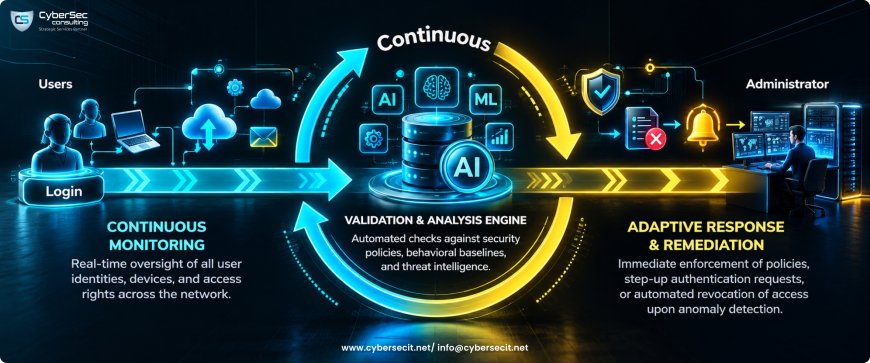
Continuous identity security validation means checking identities, access rights, and security controls continuously instead of reviewing them only once. It helps security teams maintain better visibility across users, applications, devices, and privileged accounts.
Egypt’s cybersecurity guidance places clear emphasis on Identity and Access Management, user account management, privileged account management, and periodic review of accounts and permissions.
- Continuous Monitoring of Identities and Access - Continuous monitoring tracks user identities, login activity, access requests, and account changes. IAM security teams can identify unusual access patterns and changes across cloud and enterprise environments.
- Regular Validation of Permissions and Privileges - User permissions can change as roles and responsibilities change. Regular access review helps identify excessive permissions, dormant accounts, and unnecessary privileged access. Egypt’s cloud security framework also calls for periodic review of accounts and permissions.
- Detection of Abnormal Identity Behaviour - Identity security validation looks for unusual login activity, unexpected privilege use, repeated authentication failures, and suspicious access behaviour. These signals can support cyber threat detection and faster security response.
- Verification of Security Controls - Security teams can verify whether MFA, authentication controls, access policies, privileged access controls, and identity governance are working as intended. This helps reveal gaps between documented policies and actual security operations.
- Continuous Review of Authentication and Authorization - Authentication confirms who is requesting access. Authorization determines what that identity can access. Continuous validation checks both areas as users, applications, devices, and business requirements change.
- Validation of Identity Lifecycle Processes - Identity lifecycle management covers account creation, access approval, role changes, access reviews, and account removal. Effective validation helps ensure that access is updated when an employee changes roles or leaves an organization.
Why Identity Security Changes Every Day
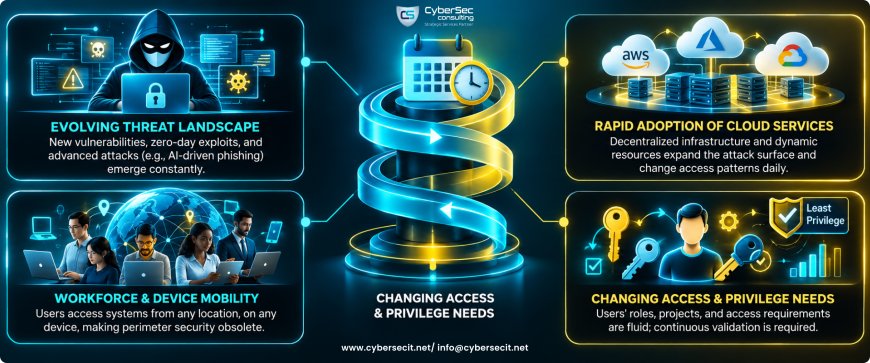
Identity security changes whenever people, applications, devices, or access requirements change. Modern organizations in Egypt depend on cloud services, digital platforms, remote access, and connected applications. Each change can create a new identity security risk. Egypt’s cloud security framework highlights the need for controlled changes, account management, access management, and privileged account management.
- New Employees and Contractors - New employees and contractors need access to business systems and applications. IAM solutions must provision the right accounts and permissions. Excessive access can increase cybersecurity risk.
- Employee Role Changes - Job responsibilities can change quickly. Access rights must change when an employee moves to another role. Regular identity governance and access reviews can help remove unnecessary permissions.
- Terminated Users - Employee termination requires fast account deactivation. Delayed access removal can leave active credentials behind. Identity lifecycle management helps control this risk.
- New Applications and Cloud Services - Organizations continue to adopt cloud applications and digital services. New systems create new authentication and authorization requirements. Egypt’s cloud security framework recognizes identity and access management as an important area of cloud security.
- Privileged Account Changes - Administrator and privileged accounts can access critical systems. Changes to these accounts require strong Privileged Access Management controls. Regular validation can identify excessive or unnecessary privileges.
- Third-Party Access - Vendors, partners, and service providers may require access to enterprise systems. Third-party access should have defined permissions, approval processes, and validity periods.
- Service Accounts - Service accounts support applications, databases, integrations, and automated processes. Unused or poorly controlled service accounts can create hidden identity risks.
- API Identities - APIs allow applications and services to communicate. API credentials and tokens must be controlled and monitored. API security and identity security should work together.
- Machine Identities - Servers, applications, workloads, and devices can use machine identities. These identities require authentication, credential protection, lifecycle management, and access controls.
- Temporary Access - Temporary access may be required for projects, support activities, or emergency operations. Access should expire when the business requirement ends.
- Remote Workforce Access - Remote employees may access business applications from different networks and devices. Zero Trust security, MFA, IAM, and continuous authentication can help organizations manage remote access risks.
Problem With Point-in-Time Identity Assessments
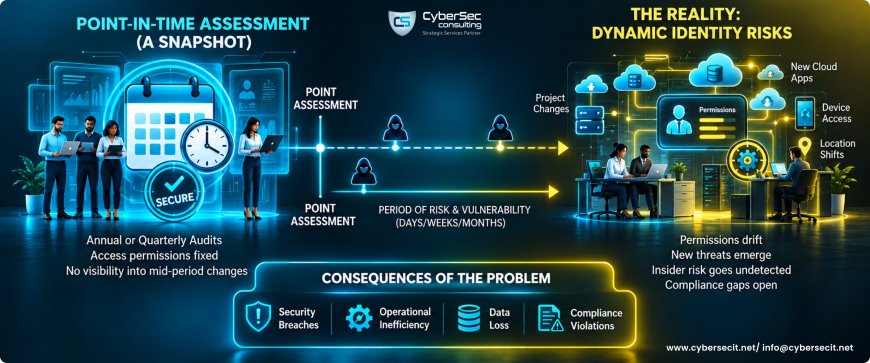
A point-in-time identity assessment provides a structured review of an organization’s IAM security posture during a defined period. It can help security teams identify access risks, permission issues, control gaps, and compliance concerns.
Continuous identity security validation addresses a different requirement. It focuses on checking identity security as users, applications, privileges, and security configurations change. Both approaches can support IAM, IGA, PAM, Zero Trust, and cybersecurity risk management.
- Assessment Reflects a Specific Point in Time - An IAM assessment captures the identity environment during the assessment period. User accounts, permissions, applications, and security controls may look different several weeks or months later.
- Permissions Can Change After an Assessment - Employee roles and business requirements change regularly. New permissions may be granted after an assessment. Previous findings may also become outdated when access requirements change.
- Dormant Accounts Can Become Active - Dormant accounts can remain unnoticed after an assessment. Reactivation can create an access risk if the account still has unnecessary permissions.
- Privileged Access Can Expand - Administrative privileges can increase as new responsibilities and projects emerge. Privileged Access Management helps security teams control these changes and review high-risk access.
- New Applications May Introduce New Identities - Cloud platforms, SaaS applications, APIs, and business systems can introduce new digital identities. Each identity can create additional authentication and authorization requirements.
- Security Configurations Can Drift - IAM policies and security configurations can change over time. Configuration drift can affect MFA, access policies, authentication controls, and privileged access settings.
- Identity Threats Can Emerge Between Reviews - Suspicious login activity, credential misuse, excessive permissions, and abnormal access can appear between scheduled assessments. Identity threat detection helps security teams monitor these changes and investigate unusual behaviour.
Identity Security Gaps That Continuous Validation Can Detect
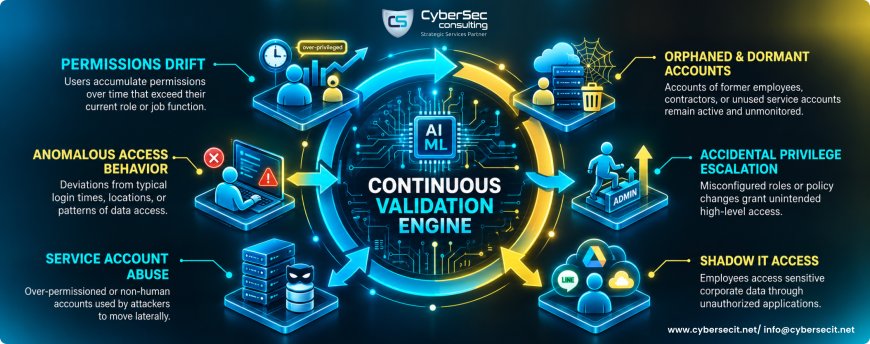
Identity environments can develop security gaps as users, applications, privileges, and access requirements change. Continuous identity security validation helps security teams identify these risks across IAM, IGA, PAM, cloud security, and Zero Trust environments.
- Excessive Permissions - Users may retain more access than their current role requires. Continuous access reviews can identify unnecessary permissions and support least privilege access.
- Privilege Escalation - Users may receive higher privileges because of role changes, project requirements, or administrative actions. Continuous monitoring can identify unexpected privilege changes.
- Dormant Accounts - Inactive accounts can retain access to business applications and sensitive systems. IAM security controls can help identify dormant identities before they create additional exposure.
- Orphaned Accounts - Orphaned accounts may remain active after the associated employee, contractor, or business relationship ends. Identity lifecycle management helps identify and remove these accounts.
- Shared Accounts - Shared credentials can reduce accountability and make user activity difficult to trace. Individual identities, strong authentication, and privileged access controls can improve identity visibility.
- Unreviewed Privileged Identities - Privileged accounts require regular access validation. PAM solutions can help security teams review administrative identities and control privileged sessions.
- Excessive Administrative Access - Administrative permissions can provide access to critical systems and sensitive data. Continuous validation can identify users who have broader administrative access than required.
- Unusual Authentication Activity - Multiple failed logins, unexpected locations, unusual login times, and abnormal authentication patterns can indicate identity security risks. Identity threat detection can help security teams investigate these signals.
- Inactive Users With Active Access - Employees who no longer require access may still have active accounts. Continuous identity lifecycle management helps align account status with current business requirements.
- Third-Party Identity Risks - Vendors, contractors, and partners can require access to enterprise systems. Continuous validation can check third-party identities, permissions, access duration, and authentication activity.
- Segregation of Duties Conflicts - A single identity may receive conflicting permissions across business processes. Identity governance and administration can help identify segregation-of-duties conflicts and support appropriate remediation.
- Access Policy Violations - Users may receive access that does not match approved security policies. Continuous access governance can identify policy violations and provide greater visibility across enterprise identities.
Continuous Validation Across the Identity Lifecycle
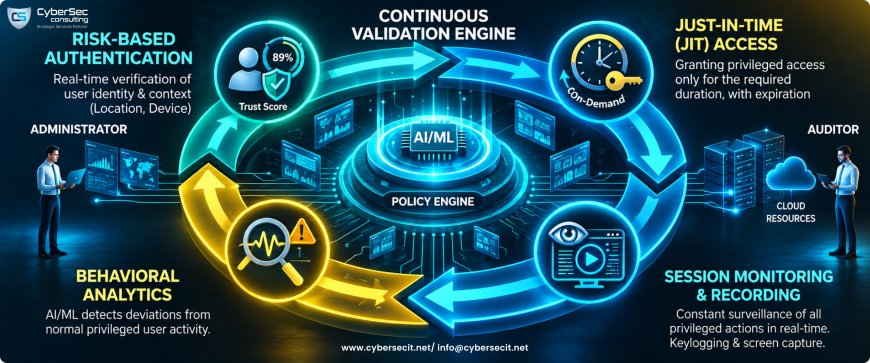
Identity security needs to follow every stage of the user lifecycle. Joiner, Mover, and Leaver processes help organizations control access as employees and contractors join, change roles, or leave the business. Continuous validation adds ongoing checks across IAM, Identity Governance and Administration, PAM, Zero Trust security, and access management.
Joiner
New employees and contractors need access to business applications, cloud platforms, and enterprise systems. Continuous validation helps ensure every access request follows approved security controls.
- Validate New Access Requests - Every new access request should match the user’s job responsibilities. IAM solutions can help security teams verify requested applications, roles, and permissions.
- Verify Approvals - Access should follow defined approval workflows. Identity governance helps verify whether managers, application owners, and security teams have approved the requested access.
- Apply Least Privilege - Users should receive only the access required for their responsibilities. Least privilege access reduces unnecessary permissions and supports stronger cybersecurity risk management.
Mover
Employee role changes can create identity security gaps. New responsibilities may require additional access. Previous permissions may no longer be necessary.
- Remove Outdated Permissions - Old access should be reviewed when employees change roles. Continuous access reviews can help remove permissions that no longer support business requirements.
- Validate Role Changes - Every role change should trigger an identity and access review. IGA solutions can help confirm that new permissions match the employee’s updated responsibilities.
- Detect Privilege Accumulation - Employees can gradually collect permissions through multiple role changes. Continuous identity security validation can identify excessive access and privilege accumulation.
Leaver
Employee departures require fast identity deprovisioning. Delayed access removal can leave active credentials and application permissions behind.
- Disable Accounts Quickly - User accounts should be disabled when employment or contractual access ends. Automated identity lifecycle management can support faster deprovisioning.
- Revoke Application Access - Access to SaaS platforms, cloud services, databases, and business applications should be removed. Continuous validation can confirm that access has actually been revoked.
- Remove Privileged Credentials - Administrative credentials require additional attention during offboarding. Privileged Access Management can help revoke privileged accounts, credentials, and active sessions.
Continuous Validation for Privileged Access
Privileged Access Management, or PAM, is a critical part of identity security. Privileged accounts can access servers, databases, cloud environments, security tools, and sensitive business systems. Continuous validation helps security teams monitor privileged access as permissions, users, and systems change.
- Privileged Account Discovery - Security teams need visibility into all privileged accounts across enterprise infrastructure. PAM solutions can help discover administrator accounts, service accounts, root accounts, and other high-privilege identities.
- Administrative Access Monitoring - Administrative activity should be continuously monitored. Security teams can review login activity, access requests, privilege changes, and administrative actions to identify unusual behaviour.
- Just-in-Time Access - Just-in-time access provides privileged permissions only when they are required. Access can be limited by time, user, system, and business purpose. This supports least privilege security and Zero Trust principles.
- Privilege Elevation - Users may require temporary elevated permissions for specific tasks. Continuous validation can verify who received elevated access, why it was granted, and whether the privilege was removed afterward.
- Session Monitoring - Privileged sessions can provide valuable security visibility. PAM security can monitor privileged sessions and support auditing of administrative activity across critical systems.
- Credential Rotation - Privileged credentials should be protected and regularly changed. Automated credential rotation can reduce exposure associated with compromised, shared, or long-lived administrator credentials.
- Privileged Access Reviews - Regular reviews can identify unnecessary administrative privileges, inactive privileged accounts, and excessive permissions. Continuous validation provides additional visibility between scheduled PAM access reviews.
- Emergency Access Validation - Emergency or break-glass accounts may be required during critical incidents. These accounts need strict controls, monitored usage, and post-event validation to confirm that emergency privileges were appropriate.
- PAM and Broader Identity Security - PAM works as part of a broader identity security strategy. IAM manages user access. IGA governs identity and entitlement processes. PAM protects privileged access. Threat detection identifies suspicious identity activity.
Continuous Validation and Identity Threat Detection

Identity activity can provide valuable signals for detecting cybersecurity threats. Continuous identity security validation helps security teams monitor authentication, access requests, privilege changes, and user behaviour across enterprise environments.
Organizations in Egypt can use identity threat detection, IAM security, Zero Trust security, and cybersecurity monitoring to identify suspicious activity across users, applications, cloud services, and privileged accounts.
- Impossible Travel - A user may appear to authenticate from geographically distant locations within an unrealistic time period. Impossible travel detection can flag this activity for further investigation.
- Unusual Login Patterns - Repeated logins at unusual times, unexpected locations, or unfamiliar applications can indicate potential account misuse. Continuous identity monitoring helps security teams identify changes in normal authentication behaviour.
- Abnormal Privilege Use - Administrative privileges may be used outside normal business requirements. Sudden privilege elevation, unexpected administrator activity, or access to unfamiliar systems can create important security signals.
- Suspicious Authentication Attempts - Multiple failed authentication attempts can indicate credential attacks or account misuse. Monitoring authentication events helps security teams investigate unusual activity earlier.
- Password Spraying Indicators - Password spraying attempts can target multiple accounts using a limited number of commonly used passwords. Repeated authentication failures across several identities can provide an important identity threat detection signal.
- MFA Anomalies - Unexpected MFA requests, repeated authentication prompts, or unusual MFA activity can indicate attempts to compromise an identity. Continuous monitoring can help identify abnormal MFA behaviour.
- New Device Authentication - A login from an unfamiliar device can require additional validation. Device identity, user context, location, and authentication behaviour can provide useful information for assessing the access request.
- Unusual Access to Sensitive Applications - Access to critical applications, databases, financial systems, or sensitive data should match the user’s business role. Unexpected access patterns can indicate compromised credentials or excessive permissions.
- Identity Telemetry as a Detection Layer - Identity telemetry provides security teams with continuous information about authentication, authorization, privilege changes, devices, applications, and user behaviour. This data can complement SIEM, SOC, threat detection, IAM, IGA, and PAM capabilities.
Why IAM Controls Can Still Fail

Deploying IAM security controls does not automatically prove that identity security is effective. Security teams may have strong technologies and documented policies. Control effectiveness still depends on correct configuration, consistent enforcement, user behaviour, and continuous monitoring.
Organizations in Egypt are adopting cloud services, digital applications, remote access, and connected business systems. These environments increase the importance of identity security, access management, Zero Trust security, and cybersecurity risk management.
- MFA Enabled - Multi-factor authentication adds an important authentication layer. Incorrect configuration, weak recovery processes, legacy applications, or authentication exceptions can still create identity risks. Continuous validation can check whether MFA security controls are applied to the right users, applications, and privileged accounts.
- PAM Deployed - A Privileged Access Management platform can control administrator access. Incorrect policies, excessive privileges, unmanaged privileged accounts, or bypass paths can reduce its effectiveness. Continuous PAM validation can verify privileged identities, access requests, elevation activity, sessions, and credentials.
- IAM Policies Configured - IAM policies define who can access systems and what they can access. Policy configuration alone does not confirm that permissions remain appropriate. Continuous identity governance can validate permissions against current roles, business requirements, and security policies.
- SSO Implemented - Single Sign-On can simplify authentication across multiple applications. SSO does not automatically remove excessive permissions or prevent compromised accounts from accessing approved applications. Continuous validation can review authentication activity, application access, user permissions, and unusual identity behaviour.
- Access Reviews Scheduled - Scheduled access reviews can help identify unnecessary permissions. Risks can emerge between review periods when users change roles, new applications are added, or privileges increase. Continuous access review and identity validation can provide additional visibility between scheduled reviews.
Security Control Validation

Security control validation means checking whether an identity security control is correctly configured, actively enforced, and producing the expected security outcome.
- Are controls configured correctly?
- Are exceptions monitored?
- Are policies being followed?
- Are users receiving excessive access?
- Can controls detect abnormal identity activity?
- Can compromised identities bypass existing controls?
Continuous Validation in Zero Trust Security

Zero Trust security treats identity and access as an ongoing security decision. Every access request requires appropriate verification. Continuous identity security validation supports this model by checking users, devices, applications, permissions, and session activity.
Organizations in Egypt adopting Zero Trust IAM can use continuous validation to strengthen access control across cloud platforms, enterprise applications, remote work environments, and sensitive systems.
- Verify Explicitly - Every access request should be evaluated using relevant security signals. Zero Trust Identity Security can validate the user, authentication method, device, application, location, and access request before granting access.
- Least Privilege - Users should receive only the permissions required for their current responsibilities. Continuous IAM security validation can identify excessive permissions and changes that increase access risk.
- Continuous Risk Evaluation - Identity risk can change during an active session. Failed authentication attempts, unusual locations, device changes, or privilege escalation can alter the risk level. Continuous Authentication helps security teams reassess identity activity as conditions change.
- Identity Context - User identity provides an important security signal. Role, department, access history, authentication activity, and privilege level can help determine whether an access request is appropriate.
- Device Context - Device security can influence access decisions. Device identity, security status, location, and authentication history can provide additional context for Zero Trust security.
- Application Context - Applications have different levels of sensitivity. Access to financial systems, databases, identity platforms, and sensitive business applications may require stronger validation.
- Session Risk - A session that begins with valid authentication can still become risky. Unexpected privilege changes, unusual activity, or suspicious access behaviour can trigger additional validation.
- Adaptive Access Controls - Adaptive access controls can respond to changing identity and security signals. Access requirements can become stricter when risk increases.
How Organizations Can Start Continuous Identity Validation

Organizations can begin continuous identity security validation by establishing visibility across users, applications, devices, privileged accounts, and access relationships. A structured approach can help security teams in Egypt strengthen IAM security, Identity Governance and Administration, PAM, Zero Trust security, and cybersecurity risk management.
- Build an Accurate Identity Inventory - Create a current inventory of workforce identities, contractors, service accounts, machine identities, API identities, and third-party users. Accurate identity visibility supports stronger IAM security and access governance.
- Identify Privileged Identities - Discover administrator accounts, privileged users, service accounts, and emergency access identities. Privileged Access Management can help control and monitor these high-risk identities.
- Map Identities to Applications and Resources - Connect users and identities to applications, databases, cloud services, systems, and sensitive resources. Identity mapping helps security teams understand who can access critical business assets.
- Review Excessive Permissions - Check whether users have more access than their current roles require. Regular access reviews can support least privilege and reduce unnecessary identity risk.
- Establish Access Review Cycles - Create defined review processes for users, applications, privileged accounts, and third-party identities. Identity governance can help automate approval and certification workflows.
- Monitor Identity Behaviour - Monitor authentication activity, access requests, privilege changes, login patterns, and unusual identity behaviour. Identity threat detection can help identify suspicious activity.
- Integrate IAM, IGA, PAM and Security Monitoring - Connect IAM, IGA, PAM, SIEM, and security monitoring capabilities. Integrated identity telemetry can provide broader visibility across the cybersecurity environment.
- Automate Remediation Where Appropriate - Automate actions for suitable identity risks. Examples include disabling inactive accounts, removing excessive permissions, revoking access, and triggering additional authentication.
- Continuously Test Identity Controls - Test whether MFA, SSO, IAM policies, PAM controls, access approvals, and lifecycle processes operate as expected. Security control validation helps confirm that deployed controls remain effective.
- Revalidate After Major Changes - Major changes can affect identity security. New applications, cloud migrations, organizational changes, acquisitions, infrastructure updates, and new privileged access should trigger additional validation.
Conclusion
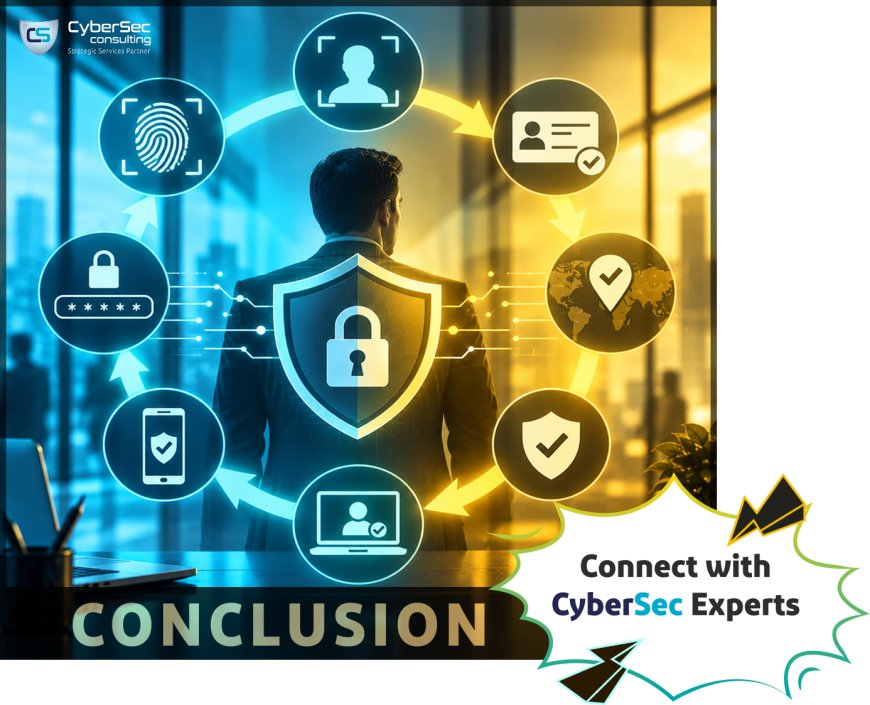
Identity security is not a one-time configuration exercise. Identities, privileges, applications, devices, and access conditions continue to change. Continuous validation helps organizations identify whether identity controls remain effective as those changes occur.
Organizations in Egypt need strong visibility across IAM security, Identity Governance and Administration, Privileged Access Management, cloud identity, access governance, and identity threat detection. Regular validation can help security teams identify excessive permissions, dormant accounts, privilege changes, suspicious authentication activity, and access policy violations.
Continuous identity validation also supports Zero Trust IAM and Zero Trust Identity Security. Security teams can continuously evaluate identity, device, application, authentication, and session context.
CyberSec Consulting helps organizations strengthen identity security across complex enterprise and cloud environments. Our capabilities cover IAM, IGA, PAM, identity assessments, managed identity services, identity monitoring, and identity security consulting.
CyberSec Consulting can help organizations assess identity risks, improve access governance, protect privileged accounts, monitor identity activity, and strengthen identity lifecycle management.
Looking to improve identity security in Egypt?
Connect with CyberSec Consulting to assess your current IAM environment and build a continuous identity security strategy.
FAQs
What is continuous identity security validation?
Continuous identity security validation is the ongoing review of identities, permissions, authentication activity, privileged access, and security controls. Organizations in Egypt can use this approach to maintain visibility across IAM, IGA, PAM, cloud identities, applications, and access relationships.
Why is continuous identity validation important for organizations in Egypt?
Identity environments change as employees change roles, new applications are introduced, and cloud services expand. Continuous validation helps organizations identify excessive permissions, dormant accounts, privilege escalation, suspicious authentication, and access policy violations.
How does continuous validation support IAM security?
Continuous validation checks whether IAM policies, permissions, authentication controls, and access approvals continue to meet business and security requirements. Regular validation can strengthen Identity and Access Management and access governance across Egyptian organizations.
How does PAM support continuous identity security?
Privileged Access Management helps control administrator and other high-privilege identities. Continuous PAM validation can monitor privileged accounts, access elevation, sessions, credentials, and emergency access.
How does continuous identity validation support Zero Trust security?
Zero Trust IAM requires access decisions to consider current identity and security context. Continuous validation can evaluate users, devices, applications, authentication activity, privileges, and session risk. This supports Zero Trust Identity Security and Continuous Authentication.
Can CyberSec Consulting help with identity security in Egypt?
CyberSec Consulting provides capabilities across IAM, IGA, PAM, identity assessments, managed identity services, identity monitoring, and identity security consulting. These services can help organizations in Egypt strengthen access governance, identity lifecycle management, privileged access security, and continuous identity validation.
- Introduction
- What Is Continuous Identity Security Validation?
- Why Identity Security Changes Every Day
- Problem With Point-in-Time Identity Assessments
- Identity Security Gaps That Continuous Validation Can Detect
- Continuous Validation Across the Identity Lifecycle
- Joiner
- Mover
- Leaver
- Continuous Validation for Privileged Access
- Continuous Validation and Identity Threat Detection
- Why IAM Controls Can Still Fail
- Security Control Validation
- Continuous Validation in Zero Trust Security
- How Organizations Can Start Continuous Identity Validation
- Conclusion
- FAQs