
Introduction
Cyberattacks targeting enterprises continue to rise across the Middle East, driven by rapid cloud adoption, digital transformation, and increasingly sophisticated threat actors. Recent industry reports show that organisations operating without strong cybersecurity compliance and governance experience significantly higher risks of ransomware, identity-based attacks, cloud breaches, and data loss.
Every security gap, unmanaged identity, weak access control, or misconfigured cloud resource creates an opportunity for attackers to compromise critical business systems. Strong cybersecurity compliance, Governance, Risk, and Compliance (GRC), cloud security, and Identity and Access Management (IAM) have become essential for reducing enterprise cyber risk and protecting digital assets.
Compliance failures have evolved into one of the most exploited attack vectors because cybercriminals actively search for organisations with weak security controls, poor governance, and incomplete risk management. Modern enterprises operate across cloud, hybrid, and on-premises environments, making continuous compliance a critical cybersecurity requirement rather than simply a regulatory obligation.
A proactive compliance strategy, supported by Zero Trust Security, Privileged Access Management (PAM), continuous monitoring, AI-driven risk assessments, and regular compliance audits, helps organisations strengthen cyber resilience, improve regulatory readiness, minimise cyber risks, and build a secure foundation for long-term digital transformation.
Why Are Compliance Gaps a Growing Cybersecurity Risk?
Compliance gaps create opportunities for cybercriminals to exploit weak security controls, poor governance, and unmanaged cyber risks. Rapid cloud adoption, evolving cyber threats, and stricter regulatory requirements have made cybersecurity compliance, GRC consulting, ISO 27001 compliance, and cloud security compliance essential for enterprise security. Organisations that fail to maintain continuous compliance face higher risks of ransomware, data breaches, identity attacks, and regulatory penalties.
Increasing Regulatory Pressure - Organisations must comply with evolving regulations such as UAE PDPL, SAMA Cybersecurity Framework, ISO 27001, and NCA Essential Cybersecurity Controls (ECC), making continuous compliance and governance critical for reducing cyber risk.
- Digital Transformation Challenges - Rapid digital transformation increases the complexity of securing cloud platforms, digital identities, and business applications, requiring strong cybersecurity compliance and proactive risk management.
- Cloud Adoption - Enterprise cloud adoption expands the attack surface, making cloud security compliance, Cloud Security Posture Management (CSPM), and continuous cloud risk assessments essential for protecting critical workloads.
- AI-Driven Cyberattacks - AI-powered cyberattacks can rapidly exploit compliance weaknesses, identity gaps, and security misconfigurations, increasing the need for AI-driven compliance monitoring and advanced threat detection.
- Third-Party Ecosystem Risks - Third-party vendors, suppliers, and cloud service providers can introduce compliance vulnerabilities, making vendor risk management and security assessments essential for enterprise protection.
- Remote Workforce Security - Hybrid and remote work environments increase identity-related risks, requiring Identity and Access Management (IAM), Zero Trust Security, and continuous compliance monitoring to secure enterprise access.
- Identity-Centric Attacks - Cybercriminals increasingly target privileged accounts, user identities, and authentication systems, making Identity Governance, Privileged Access Management (PAM), and Multi-Factor Authentication (MFA) essential for preventing identity-based attacks.
What Are Compliance Gaps?
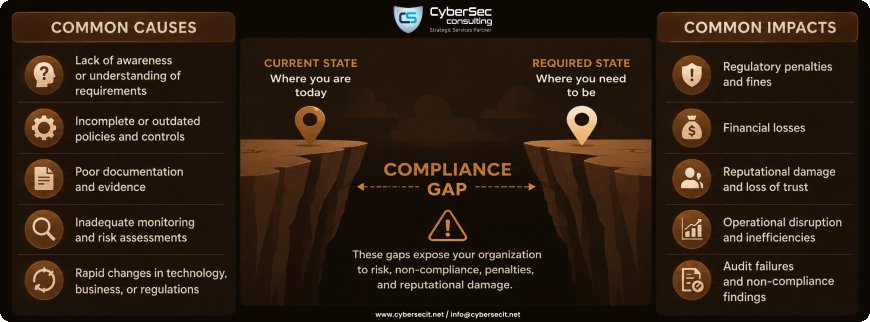
Compliance gaps are weaknesses in security controls, governance, policies, or operational processes that leave organisations exposed to cyber threats and regulatory violations. These gaps increase the risk of ransomware, identity-based attacks, cloud breaches, and data loss across enterprise environments. Regular cybersecurity compliance assessments, GRC consulting, ISO 27001 implementation, and cloud security compliance help identify and eliminate these risks before attackers exploit them.
- Missing Security Controls - Missing technical and administrative security controls create exploitable weaknesses that increase cyber risk and prevent organisations from achieving effective cybersecurity compliance.
- Weak Governance - Poor governance frameworks reduce security oversight, weaken accountability, and make it difficult to enforce enterprise cybersecurity policies and regulatory compliance.
- Poor Documentation - Incomplete or outdated security documentation affects audit readiness, delays compliance assessments, and increases the likelihood of regulatory non-compliance.
- Unpatched Vulnerabilities - Delayed security patching leaves critical systems, cloud workloads, and enterprise applications vulnerable to ransomware, malware, and other cyberattacks.
- Ineffective Identity Management - Weak Identity and Access Management (IAM) practices increase the risk of unauthorised access, privileged account abuse, and identity-based cyber threats.
- Lack of Monitoring - Insufficient continuous monitoring reduces visibility into security events, delaying threat detection and increasing the impact of cyber incidents.
- Incomplete Risk Assessments - Inadequate cyber risk assessments fail to identify critical vulnerabilities, compliance gaps, and emerging threats across cloud, hybrid, and on-premises environments.
- Weak Incident Response Planning - An ineffective incident response plan slows cyberattack containment, extends business disruption, and increases financial, operational, and regulatory impact.
How Do Cybercriminals Identify Compliance Weaknesses?

Cybercriminals actively search for compliance weaknesses before launching enterprise attacks. Weak governance, poor identity security, cloud misconfigurations, and inadequate security controls provide easy entry points into business environments. Regular cybersecurity compliance assessment, GRC consulting, cloud security assessments, and Zero Trust security help organisations identify and eliminate these risks before attackers can exploit them.
- Public Information Gathering - Attackers collect publicly available information about employees, technologies, cloud platforms, vendors, and business operations to identify compliance weaknesses and plan targeted cyberattacks.
- Vulnerability Scanning - Automated tools scan enterprise networks, cloud infrastructure, and internet-facing applications to identify unpatched systems, security misconfigurations, and compliance gaps that can be exploited.
- Credential Harvesting - Cybercriminals use phishing campaigns, credential theft, and malicious websites to capture user credentials and gain unauthorised access to enterprise systems and cloud environments.
- Identity Enumeration - Attackers identify privileged accounts, service accounts, administrative users, and authentication methods to exploit weaknesses in Identity and Access Management (IAM) and launch identity-based attacks.
- Cloud Reconnaissance - Cloud environments are analysed to discover exposed storage, excessive permissions, insecure APIs, and cloud configuration weaknesses that increase enterprise cyber risk.
- Third-Party Exploitation - Vendors, suppliers, contractors, and managed service providers are targeted to exploit weak third-party security controls and bypass enterprise cybersecurity compliance.
- Supply Chain Mapping - Attackers analyse software providers, cloud services, technology partners, and business dependencies to identify vulnerable links that can be leveraged for supply chain attacks.
- Social Engineering - Phishing, impersonation, business email compromise (BEC), and other social engineering techniques are used to manipulate employees, steal credentials, and bypass enterprise security controls despite existing compliance programmes.
Top Compliance Gaps That Attackers Exploit
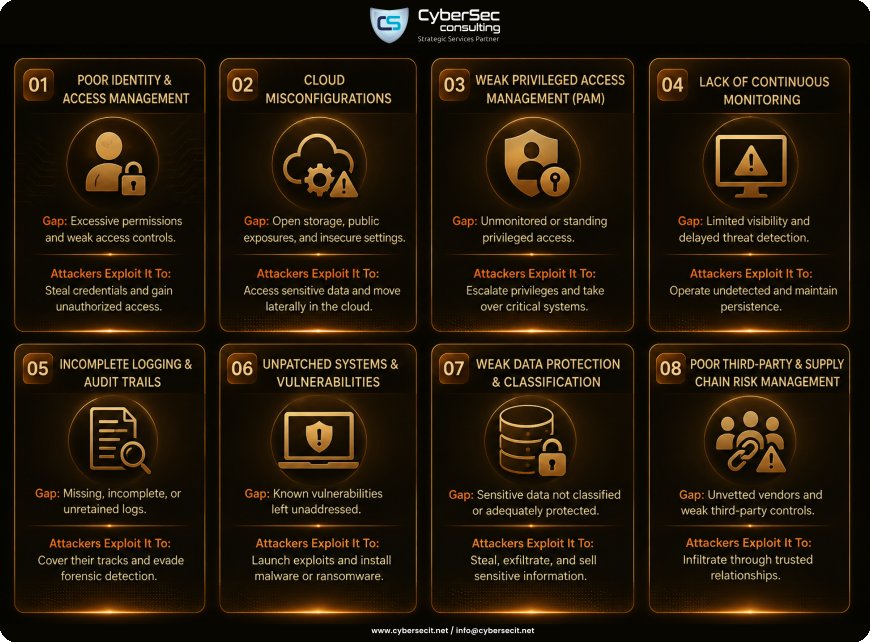
Cybercriminals actively exploit compliance gaps to bypass enterprise security controls and gain unauthorised access to critical systems. Weak identity security, poor governance, cloud security misconfigurations, and ineffective monitoring significantly increase cyber risk across modern organisations. Closing these gaps through cybersecurity compliance consulting, GRC services, Zero Trust Security, and continuous compliance monitoring strengthens cyber resilience and reduces the likelihood of enterprise cyberattacks.
- Weak Identity and Access Management (IAM) - Weak Identity and Access Management (IAM) controls allow attackers to compromise user identities, gain unauthorised access, and exploit enterprise systems, making IAM implementation and identity governance essential.
- Excessive Privileged Access - Overprivileged accounts increase the attack surface by giving users and administrators unnecessary permissions that attackers can exploit through privilege escalation and credential compromise.
- Missing Multi-Factor Authentication (MFA) - Missing Multi-Factor Authentication (MFA) leaves enterprise accounts vulnerable to credential theft, phishing attacks, and account takeover, increasing the risk of identity-based cyberattacks.
- Poor Password Policies - Weak password policies enable brute-force attacks, password spraying, and credential reuse, making strong password governance a critical component of cybersecurity compliance.
- Cloud Misconfigurations - Misconfigured cloud environments expose sensitive data, storage resources, and critical workloads, making cloud security assessments and Cloud Security Posture Management (CSPM) essential for reducing cloud security risks.
- Unpatched Systems - Unpatched operating systems, applications, and cloud workloads provide attackers with exploitable vulnerabilities that can lead to ransomware infections, data breaches, and business disruption.
- Shadow IT - Unauthorised applications, cloud services, and unmanaged devices reduce security visibility, create compliance gaps, and increase enterprise exposure to cyber threats.
- Weak Vendor Risk Management - Poor third-party security governance allows attackers to exploit vendor relationships, supply chain dependencies, and external service providers to compromise enterprise environments.
- Lack of Continuous Monitoring - Limited security monitoring delays threat detection, reduces incident visibility, and enables attackers to remain undetected, highlighting the importance of continuous compliance monitoring and Security Operations Centre (SOC) services.
- Missing Security Awareness Training - Employees without regular cybersecurity awareness training are more likely to fall victim to phishing, social engineering, and credential theft, making security education a key element of enterprise cybersecurity compliance.
Common Enterprise Cyberattacks Caused by Compliance Failures
Compliance failures create security gaps that cybercriminals exploit to launch sophisticated attacks against enterprise environments. Weak governance, poor identity security, cloud misconfigurations, and inadequate risk management increase exposure to financial loss, operational disruption, and regulatory penalties. Implementing cybersecurity compliance consulting, GRC services, Zero Trust Security, Identity and Access Management (IAM), and continuous compliance monitoring helps organisations minimise cyber risk and strengthen enterprise resilience.
- Ransomware - Weak cybersecurity compliance and delayed patch management allow ransomware operators to encrypt critical systems, disrupt business operations, and demand costly ransom payments.
- Business Email Compromise (BEC) - Poor email security controls, missing Multi-Factor Authentication (MFA), and weak identity governance enable attackers to execute Business Email Compromise (BEC) attacks and commit financial fraud.
- Insider Threats - Inadequate access governance, excessive user permissions, and weak monitoring increase the risk of malicious or accidental insider threats affecting sensitive business data.
- Cloud Data Breaches - Cloud security misconfigurations, poor access controls, and weak cloud security compliance expose confidential information to unauthorised access and large-scale data breaches.
- Credential Theft - Weak authentication controls and ineffective Identity and Access Management (IAM) make it easier for attackers to steal credentials and gain unauthorised access to enterprise systems.
- Privilege Escalation - Excessive privileged access and poor Privileged Access Management (PAM) controls allow attackers to elevate permissions and compromise critical enterprise infrastructure.
- Supply Chain Attacks - Weak third-party risk management and incomplete vendor security assessments create opportunities for attackers to compromise organisations through trusted suppliers and technology partners.
- API Attacks - Poor API governance, insecure integrations, and inadequate compliance controls expose enterprise applications to API attacks, data manipulation, and unauthorised access.
- Account Takeover - Missing Multi-Factor Authentication (MFA), weak password policies, and insufficient identity monitoring enable attackers to hijack enterprise user and administrator accounts.
- Data Exfiltration - Lack of continuous monitoring, weak data protection controls, and ineffective compliance governance allow attackers to steal sensitive business information without early detection.
How Is AI Transforming Compliance and Cybersecurity?

Artificial Intelligence (AI) is transforming cybersecurity compliance by enabling organisations to identify risks faster, automate governance processes, and strengthen enterprise security. AI-powered compliance continuously analyses security controls, user activities, cloud environments, and regulatory requirements to reduce cyber risk and improve operational resilience. Combined with cybersecurity compliance consulting, Governance, Risk, and Compliance (GRC), Zero Trust Security, and cloud security compliance, AI helps organisations build a proactive, intelligent, and future-ready compliance strategy.
- Detect Compliance Gaps - AI continuously identifies compliance gaps across security controls, cloud environments, identity systems, and governance processes, enabling faster remediation and stronger cybersecurity compliance.
- Identify Security Misconfigurations - AI detects cloud security misconfigurations, policy violations, excessive permissions, and configuration weaknesses that increase enterprise cyber risk and regulatory exposure.
- Monitor User Behaviour - AI analyses user behaviour, privileged account activity, and access patterns to identify anomalies, reduce identity-based cyber risks, and strengthen Identity and Access Management (IAM).
- Automate Compliance Reporting - AI automates compliance reporting, audit evidence collection, and policy validation, helping organisations improve audit readiness while reducing manual compliance efforts.
- Predict Cyber Risks - AI uses predictive analytics and threat intelligence to identify emerging cyber risks, prioritise vulnerabilities, and support proactive cyber risk management before attacks occur.
- Improve Governance - AI strengthens governance by continuously validating security policies, monitoring regulatory compliance, and supporting enterprise Governance, Risk, and Compliance (GRC) programmes.
- Detect Insider Threats - AI identifies suspicious user behaviour, privileged account misuse, credential abuse, and insider threats through advanced behavioural analytics and continuous security monitoring.
- Support Continuous Compliance - AI enables continuous compliance by monitoring security controls, tracking regulatory changes, identifying compliance violations, and supporting ongoing alignment with frameworks such as ISO 27001, UAE PDPL, SAMA Cybersecurity Framework, and NCA Essential Cybersecurity Controls (ECC).
Building a Compliance-First Cybersecurity Strategy
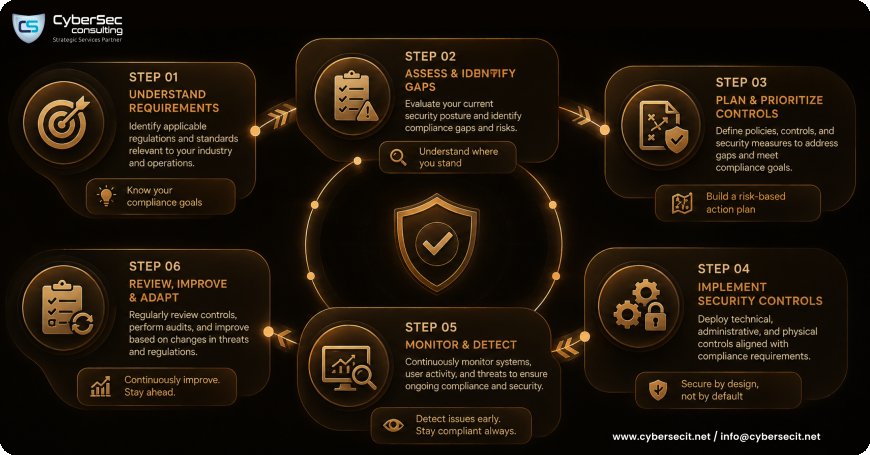
A compliance-first cybersecurity strategy helps organisations reduce cyber risk, strengthen governance, and protect critical business assets against evolving cyber threats. Integrating cybersecurity compliance, Governance, Risk, and Compliance (GRC), Zero Trust Security, Identity and Access Management (IAM), and continuous risk management creates a resilient security framework that supports business growth and regulatory compliance. A proactive roadmap also improves audit readiness, enhances cloud security, and enables secure digital transformation.
- Governance - Establish a robust Governance, Risk, and Compliance (GRC) framework that defines security policies, accountability, and regulatory alignment to strengthen enterprise cybersecurity and compliance.
- Risk Assessment - Perform regular cyber risk assessments and compliance gap assessments to identify vulnerabilities, prioritise risks, and improve security across cloud, hybrid, and on-premises environments.
- Security Controls - Implement layered security controls, including Zero Trust Security, endpoint protection, data security, and cloud security controls to minimise cyber risks and improve regulatory compliance.
- Identity Security - Strengthen Identity and Access Management (IAM), Privileged Access Management (PAM), Multi-Factor Authentication (MFA), and Identity Governance to prevent unauthorised access and identity-based cyberattacks.
- Continuous Monitoring - Enable continuous security monitoring through Security Operations Centre (SOC) services, AI-driven threat detection, and compliance monitoring to identify cyber threats and policy violations in real time.
- Incident Response - Develop and regularly test an incident response plan that enables rapid threat containment, regulatory reporting, business continuity, and faster recovery from cybersecurity incidents.
- Compliance Audits - Conduct periodic ISO 27001 compliance audits, regulatory assessments, and security reviews to identify compliance gaps, improve audit readiness, and strengthen enterprise cyber resilience.
- Executive Reporting - Deliver executive-level cybersecurity and compliance reporting that provides clear visibility into cyber risks, compliance posture, governance performance, and strategic security improvements for informed business decision-making.
Future of Compliance in Enterprise Cybersecurity
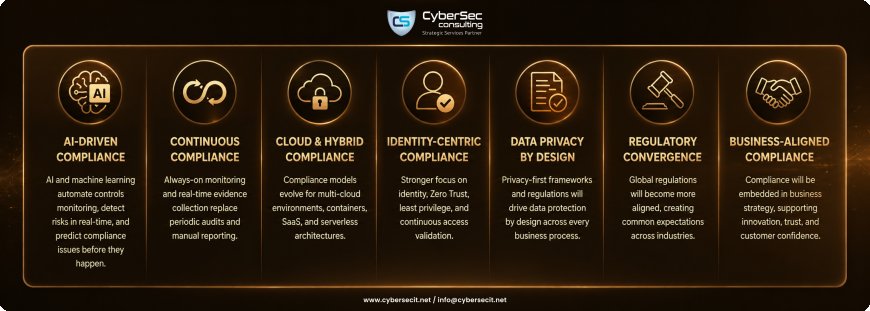
The future of enterprise cybersecurity depends on intelligent, continuous, and automated compliance that adapts to evolving cyber threats and regulatory requirements. AI, automation, and identity-centric security are transforming how organisations manage governance, reduce cyber risk, and maintain regulatory compliance across cloud, hybrid, and on-premises environments. Investing in cybersecurity compliance consulting, Governance, Risk, and Compliance (GRC), AI-powered compliance, and Zero Trust Security enables organisations to build a resilient and future-ready cybersecurity strategy.
- AI-Powered Compliance - AI-powered compliance continuously analyses security controls, identifies compliance gaps, and automates risk detection to strengthen enterprise cybersecurity and improve regulatory compliance.
- Continuous Compliance Monitoring - Continuous compliance monitoring provides real-time visibility into security controls, policy violations, and regulatory requirements, helping organisations maintain a strong compliance posture.
- Autonomous Governance - Autonomous governance uses AI-driven automation to enforce security policies, validate compliance controls, and streamline governance processes while reducing manual effort.
- Predictive Risk Intelligence - Predictive risk intelligence leverages AI and advanced analytics to identify emerging cyber risks, prioritise vulnerabilities, and prevent attacks before they impact business operations.
- Compliance Automation - Compliance automation simplifies audit preparation, policy enforcement, evidence collection, and regulatory reporting, improving operational efficiency and accelerating compliance readiness.
- Identity-First Security - Identity-first security strengthens Identity and Access Management (IAM), Privileged Access Management (PAM), and identity governance to protect users, privileged accounts, and digital identities from evolving cyber threats.
- Zero Trust Compliance - Zero Trust compliance continuously verifies users, devices, applications, and workloads while enforcing least-privilege access to reduce cyber risk and support regulatory compliance.
- Cloud-Native Compliance - Cloud-native compliance secures cloud infrastructure, workloads, applications, and data by integrating continuous compliance monitoring, Cloud Security Posture Management (CSPM), and cloud governance best practices.
- AI-Driven Audit Readiness - AI-driven audit readiness automates compliance evidence collection, validates security controls, and generates accurate audit reports to improve compliance efficiency and reduce audit complexity.
- Real-Time Regulatory Reporting - Real-time regulatory reporting provides executives and compliance teams with continuous insights into compliance status, cyber risks, and governance performance, enabling faster decision-making and proactive regulatory management.
Conclusion

Cybercriminals no longer rely only on software vulnerabilities to breach enterprise environments. Compliance gaps, weak identity security, poor governance, cloud misconfigurations, and ineffective risk management have become primary attack paths.
Strong cybersecurity compliance, Governance, Risk, and Compliance (GRC), Zero Trust Security, Identity and Access Management (IAM), Privileged Access Management (PAM), AI-driven governance, and continuous monitoring help organisations reduce cyber risk, strengthen regulatory compliance, and improve long-term cyber resilience.
Every compliance assessment completed today reduces the likelihood of tomorrow's cyberattack. Growing regulatory expectations demand a proactive approach to cybersecurity.
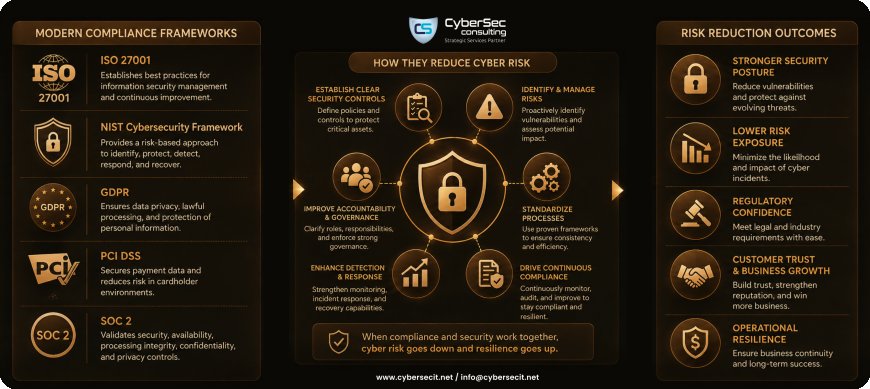
Organisations that adopt ISO 27001, UAE PDPL, SAMA Cybersecurity Framework, NCA Essential Cybersecurity Controls (ECC), PCI DSS, and NIST Cybersecurity Framework build stronger security foundations while supporting secure digital transformation.
Proactive governance, continuous compliance, and intelligent risk management enable businesses to protect critical assets, improve audit readiness, and stay resilient against evolving cyber threats.
CyberSec Consulting delivers end-to-end Cybersecurity Compliance Consulting, Governance, Risk, and Compliance (GRC) services, Compliance Gap Assessments, Cyber Risk Assessments, ISO 27001 Implementation, Data Privacy Consulting, Cloud Security Compliance, Identity and Access Management (IAM), Privileged Access Management (PAM), Zero Trust Security, Security Awareness Training, and Managed Cybersecurity Services.
Our cybersecurity experts help organisations identify compliance gaps, strengthen governance, implement security controls, and align with leading regulatory frameworks.
Every engagement is tailored to business objectives, industry regulations, and enterprise risk profiles. CyberSec Consulting helps organisations reduce cyber risk, improve compliance maturity, strengthen cloud and identity security, achieve audit readiness, and build a resilient cybersecurity programme that supports long-term business growth.
FAQs
What are compliance gaps in cybersecurity?
Compliance gaps are weaknesses in security controls, governance, policies, or risk management that expose organisations to ransomware, identity attacks, cloud breaches, and regulatory non-compliance. Regular cybersecurity compliance assessments help identify and remediate these risks.
How do cybercriminals exploit compliance gaps?
Cybercriminals exploit weak Identity and Access Management (IAM), poor cloud security, excessive privileged access, missing Multi-Factor Authentication (MFA), and ineffective governance to gain unauthorised access and compromise enterprise environments.
Which compliance frameworks help reduce enterprise cyber risk?
Leading frameworks such as ISO 27001, UAE PDPL, SAMA Cybersecurity Framework, NCA Essential Cybersecurity Controls (ECC), PCI DSS, and NIST Cybersecurity Framework help organisations strengthen cybersecurity, improve governance, and achieve regulatory compliance.
How does AI improve cybersecurity compliance?
AI strengthens cybersecurity compliance by detecting compliance gaps, identifying cloud security misconfigurations, monitoring user behaviour, automating compliance reporting, predicting cyber risks, and supporting continuous compliance monitoring.
Why is continuous compliance important for modern enterprises?
Continuous compliance enables organisations to identify security gaps in real time, improve audit readiness, reduce regulatory risk, strengthen cloud security, and protect critical business assets against evolving cyber threats.
How can CyberSec Consulting help improve enterprise cybersecurity compliance?
CyberSec Consulting provides Cybersecurity Compliance Consulting, GRC Consulting, Compliance Gap Assessments, ISO 27001 Implementation, Cloud Security Compliance, IAM, PAM, Zero Trust Security, and Managed Cybersecurity Services to help organisations reduce cyber risk and strengthen regulatory compliance.